Sabledrake Magazine
August, 2002
Feature Articles
CTF 2187: Divided but Not Conquered
Regular Articles
Resources
GURPS Harry Potter
Copyright © 2002 By Thomas Barnes
Part 2 of 5
Part 1 | Part 2 | Part 3 | Part 4 | Part 5
[Editor's Note: This article was so long and so well written, that we decided to break it up into five parts. All five have been completed, and you'll see the next three sections over the next year.]
Chapter 3 - Races and Beasts
Humans aren’t the only inhabitants of the world of Harry Potter. Various non-human magical races exist. Their cultures and governments exist along with that of the Wizarding world, and although the wizards are the most numerous and powerful race, they must treat the other races with respect.
Centaurs (10 points): Centaurs in GURPS Harry Potter are identical to Centaurs in GURPS Fantasy Folk, with the exception that they are Primitive (TL3) [-45 points] and most have Intolerance (Humans) [-10] and the Odious Personal Habit (Aloof, Arcane, Philosophical and Fatalistic, -2) [-10 points].
Most centaurs avoid humans and try to speak to them as little as necessary, although they will not attack humans unless severely provoked. If questioned by a human, most centaurs speak in riddles or obscure metaphors to bring the conversation to a close as quickly as possible. Most Centaurs seem to be fatalistic, letting astrologic signs guide their actions, because of this, they might have the Astronomy and Astrology skills. They might also know the Divination (Astrology) spell. In the latter case, centaurs might be powerful diviners; although they would be reluctant to share their knowledge with humans. Centaurs are only appropriate as NPCs.
Centaurs govern their own affairs and have little contact with wizards. At their own request, the Ministry of Magic has classified Centaurs “beasts.” The centaurs requested this change both because they objected to sharing “being” status with sinister races such as Hags and Vampires and because they wished to have nothing to do with the wizarding world.
Goblins (-15/-20 points): Goblins are an aloof, enigmatic race to whom the wizards have delegated most of their finances. Goblins are nearly identical in statistics to the Goblins described in GURPS Fantasy Folk, but are shorter (3’ 6” to 4’ 6” tall), slightly more heavy-set and have large green eyes, swarthy faces, pointed beards and sharp teeth. Their hands and feet are extremely long. Reduce ST by 1 [-10], Replace Impulsiveness with Greed [-10 points] especially for precious metals and add Sharp Teeth [5 points]. Goblins, like Wizards, tend to be Primitive (TL5/6) [-10/-5 points]. Goblins speak their own language (Gobbledygook) and must learn English as a non-native language.
Although Goblins live among wizards, they don’t seem to particularly like them. Goblins come across as being aloof and quarrelsome. Historically, goblins have deliberately sabotaged negotiations between the sentient races; either as an object lesson or as a practical joke. There have been many goblin rebellions; presumably against the hegemony imposed on the goblins by the Ministry of Magic and its predecessors.
Goblins are best known to wizards as from Gringott’s bank. If this institution can be taken as typical of goblin culture, Goblins seem to be brusque; with a preference for deep subterranean environments and a deep affinity for magic and magical traps.
Giants (105 points): Giants in the Harry Potter world are identical to the Large Giants in Fantasy Folk, except that they can breed with wizards to produce Half-Giants. They stand about 20’ tall and have dark eyes, dark hair and light brown or olive skin. Giants have a history of violence and warring among themselves. When Voldemort held power, many giants allied themselves with him and massacred Muggles; others withdrew to remote mountain ranges. Their numbers are in decline and in Britain they are believed to be extinct.
Giants add the following disadvantages to the Fantasy Folk template: Bad Racial Reputation (Dangerous and Destructive, -2) [-10]; Dying Race [-5]; Intolerance (Humans) [-10] and Primitive (TL3) [-20].
Ghosts (151 points): Ghosts use the Old Ghost template found on p. 69 of GURPS Undead. Typical Ghost compulsions are relatively minor, and might consist of “Haunt a Particular Place,” “Haunt the people who made you miserable in life,” or “Continue to Teach.” Ghosts in the Harry Potter world (at least those at Hogwarts) act as faculty and staff and are generally friendly towards the living staff and students, but they presumably are exceptional. A more typical ghost might be expected to be more hostile to the living - at least to the extent of scaring them away.
Harry Potter Ghosts also have the Anosmia (Limitation: Can barely taste or smell very strong flavors or scents. -20%) [-4] disadvantage. It is also possible that ghosts have either the Cooling (Limitation: Involuntary, -75%) [3] or Icy Weapon [15] Natural Attacks, or a similar magic knack, since they are able to cause a chill in mortal creatures they touch. If the touch of a ghost merely causes mild discomfort to humans, this is nothing more than a Racial Quirk [-1].
Half-Giants (205 points): Half giants are the offspring of a wizard and a giant. They look like unusually large, broadly-built humans and stand 9-10’ tall. Half-giants are rare and don’t fit in well with either giant or human culture. Wizards consider them to be bad-tempered and dangerous and giants consider them to be overgrown humans; with all the human vices and weaknesses that giants abhor. As a result, they tend to keep to themselves or try to pass themselves off as “large-boned” humans. Hagrid is a half-giant. Half-Giants have ST 20 [110]; HT +4 [45] and DX -1 [-10]. They have the advantages DR +3 [15]; High Pain Threshold [10]; Increased Hit Points +6 [30]; Longevity [5] and Magery [15].
They have the disadvantages of Inconvenient Size [-10] and Social Stigma (Second-Class Citizen) [-5].
House Elf (-92 points): House Elves are an intelligent form of faerie. They are dedicated, unpaid servants to wizards. House Elves look like small 2-3’ wizened humanoids with light brown skin, large bat-like pointed ears, luminous green eyes and large oddly-shaped noses (either long and pointed or bulbous and clown-like).
House elves are typically encountered as the servants of wealthy, old magical families. Their slave mentality requires them to serve their master faithfully, regardless of the danger or abuse their duties might require, and never betray their master’s secrets. A house-elf can operate on its own, but vastly prefers to have a master to give it directions and a sense of belonging. While a house elf won’t starve to death if its master forgets to tell it to eat, it would starve itself to death if its master gave it orders to do so.
As a mark of their servitude, house elves do not wear normal clothing. In fact, if the house elf’s master gives it a proper piece of clothing - even a worn-out garment - the house-elf is released from the master’s service. Depending on the situation and the house-elf’s personality, it might consider this a blessing or a mark of shame. In any case, a house-elf who is dismissed from one master’s service will soon take up service with another master. Due to their low initiative, house elves are best used as NPCs. It is possible that a player might have an exceptional house elf as an Ally.
House Elves have ST -5 [-50]; DX +1 [10]; IQ-2 [-15]; HT +2 [20] and 4 levels of Reduced Hit Points [-20]. They have the advantages of Acute Hearing +2 [4]; Acute Smell/Taste +2 [4]; High Pain Threshold [10]; Less Sleep x 5 [15]; Longevity [5]; Magery [15]; Night Vision [10]; Pitiable [-5] Racial Group Skill Bonus to “domestic” Artistic and Craft skills (+2 bonus) [12]; and Silence x 1 [5].
They have the disadvantages of Compulsive Behavior (Cook, Clean, Make and Mend) [-10]; Inconvenient Size [-10]; Low Self-Esteem [-10]; Primitive (TL5) [-15]; Selfless [-10]; Sense of Duty (Owner and his family) [-10]; Slave Mentality (Partial) [-20]; Social Stigma (Valuable Property) [-10];Vow (Minor) (Do Not Wear Normal Clothes) [-5]; Vow (Never Tell Their Master’s Secrets or Speak Ill of Their Master) [-5]; Wealth (Dead Broke) [-25]; Workaholic [-5].
They have the Racial Skill of Stealth at DX level; it is a mark of a good house-elf that they can go about their business without being noticed.
An experienced house elf will also know about 20 points in spells; mostly from the Food, Making and Breaking and Movement colleges. They can use these spells without needing a wand as a focus, but they cannot use them without their master’s implicit permission. These limitations and enhancements cancel each other out. An elf can use a wand; gaining a +2 bonus to skill (or +4 for an attuned wand), but it is illegal for house elves to own or use wands.
Leprechaun (-23 points): Leprechauns are a rare, intelligent form of Irish faerie. They are identical to the Leprechauns in GURPS Fantasy Folk except that they have IQ -1 [-10]; Primitive (TL3) [-40] and Trickster [-15] disadvantages. Their advantages include Magery [15] and the Racially Learned Magic spells False Coins at IQ+3 [6, including Magery] and Flight IQ+2 [6, including Magery]. They have green skin and, unless they can get something better, make clothes out of leaves. They are best used as NPCs.
Merfolk (-10 points): Merfolk are aloof, aquatic beings that inhabit both fresh and salt water. They are distinctly inhuman in appearance, even discounting their fishy tails. Their humanoid half has grayish skin, long green hair, large yellow eyes and pointed teeth. They fish with spears. Above water, their voices are unintelligible (this is the 0 point version of the Speak Underwater advantage). They are identical to the Merfolk in GURPS Fantasy Folk, with the exception that they have the Primitive (TL3) [-20] disadvantage and the Sharp Teeth [5] advantage.
Merrows are Scottish and Scandinavian merfolk. They have Unattractive or worse appearance. Merfolk are best used as NPCs.
Merfolk govern their own affairs and have little contact with wizards. Like centaurs, they have voluntarily asked to be classified as “beasts.”
Poltergeist (155 points): Poltergeists are a form of ghost, but with a -10 point Compulsion to make noise, break things, play practical jokes and generally be obnoxious. Individual poltergeists will have additional Odious Personal Habits worth -5 to -15 points. Poltergeists tend to Materialize more than most ghosts, mostly so they can wreak havoc in the material world.
Veela (53 points): Veela are Eastern European nature spirits with the power to enchant men with their voices. They look like extremely beautiful fair-haired, light-eyed human women, except when they are angry, where their appearance becomes fearsome instead.
Veela have magic hypnosis powers over men. When a veela sings or talks, any male human (or similar race) who can hear her must roll vs. Will or be drawn to the veela, doing whatever it takes to impress her, even if it is stupid or dangerous. Though they can see that other people are acting in a stupid or reckless way, they don’t notice their own foolishness. As long as the veela sings or talks, her victims will continue to cluster around her, ignoring their surroundings and jockeying for her attention. If more than one veela sings, increase the radius of their power and the number of victims that can be affected. If a potential victim thinks to cover his ears, or has the Hard of Hearing disadvantage, he gets +2 to his effective Will roll. Characters with the Deaf disadvantage or who use spells or technology to completely block their ears are immune to the veela’s song, as are women.
Veela can interbreed with wizards, producing offspring of exceptional beauty, but without their mother’s shapeshifting powers. Because of their rarity, they are best used as NPCs.
Veela have the advantages of Very Beautiful [25], Magery 2 [25] and Racial Magic Spell (Mass Suggestion-15) (Limitation: Men Only. -25%), (Limitation: Limited to Suggestions of “Try to Impress Me.” -25 %.) (Limitation: Must sing or speak. -25 %.) [4]. They also have a bird-like form which has the following advantages and disadvantages: Alternate Form [5]; Flight (Limitations: Winged, Cannot Hover, Only in Bird-Form -50 %.) [20]; Peripheral Vision (Limitation: Accessibility. Only in Bird-Form. -25%) [7]; Sharp Teeth (Beak) (Limitation: Accessibility. Only in Bird-Form. -25%) [4]; and Appearance (Ugly) (Limitation: Accessibility. Only in Bird-Form. -25%) [-7]. In either form, they have the disadvantages of Bad Temper [-10], Selfish [-5] and Primitive (TL5) [-15].
Werewolf (-64/-84 points): A werewolf is a human (wizard or muggle) who turns into a werewolf when the moon is full. Unlike an animagus A “hereditary” werewolf cannot control his changes and becomes a ravening monster with a taste for human flesh.
A werewolf who can keep his problem secret has a disadvantage worth -64 points. A known werewolf will be treated as a dangerous outsider by wizarding society. If the were poses a threat to society he will be hunted down by the Ministry of Magic. Alternatively, a werewolf can register with the appropriate Ministry of Magic office and can try to live as best he can in the midst of human society. In the latter case, the only real alternative is for the werewolf to go into voluntary exile from the rest of humanity during the month and to imprison himself in a sturdily-built, locked room on the nights of his transformation. A known werewolf has a disadvantage worth -84 points.
Advantages: Shapeshifting (Werewolf) (Limitation: Involuntary changes when exposed to the light of the full moon, can’t shapeshift otherwise, -75%). [4].
Disadvantages: Berserk (Limitation: Only in Werewolf form, resisted with Will roll, roll once per minute. -75%.) [-4]; Bestial (Limitation: As above. -75%) [-5]; Bloodlust (Limitation: As above. -75%). [-4], Infectious Attack [-5]; Odious Racial Habit (Eats Humans) [-15]; Painful Transformation [-5] and Vulnerability x 1 (Silver) [-10].
A “secret” werewolf will have the Secret (Werewolf) [-20] disadvantage.
A known werewolf will have the Social Stigma (Outsider) [-15] and one of either Enemy (Werewolf Hunters, Medium Group, 9-) [-20] or Duty (Imprisonment on nights of the full moon, 6-) [-5] and Great Vow (Self-exile from humanity) [-15].
Wizarding Animals
Wizarding animals are unusually large, intelligent, loyal and long-lived. Use the Animal templates from GURPS Bestiary, but increase IQ by 1-3 points (depending on the type of animal) to a maximum of 8 and remove any levels of Short Lifespan. Add Sense of Duty (Owner) [-5]. Due to their low point cost, low IQ and lack of magical ability, even wizarding animals make poor PCs. They do, however, make excellent NPCs and might even count as Allies.
Though they are similar to familiars in many ways, wizarding animals are companions and allies, not familiars in the usual sense.
Wizard’s Cat (-29 points): Use the Cat template on p. BE108, but increase IQ by 2 (to 7) [+20]. Remove Short Lifespan [+50]. Add Silence x 2 [10], and Sense of Duty (Owner) [-5].
Wizard’s Owl (51 points): Owls come in a variety of sizes from tiny screech owls to large eagle owls. This template describes a moderately large owl such as a barn, eagle, or snowy owl. Unlike normal owls, wizarding owls are comfortable operating during the day. Since they are commonly used to carry messages, they also have magical powers of direction and tracking. Hedwig, Harry Potter’s owl, is a snowy owl and would use this template.
Attributes: ST -8 [-70]; DX +4 [45]; IQ -3 [-20]; HT +2 [15]; Reduced Hit Points -5 [-25].
Advantages: Acute Hearing +5 [10], Alertness +5 [25]; Attractive [5], Chameleon x 2 (Limitation: Natural Camouflage, only works in natural outdoor environment. -50%.) [8]; Decreased Life Support [10], Early Maturation 3 [15]; Enhanced Move (Flying) x 1-1/2 [15]; Flight (Winged, Cannot Hover) [24]; Increased Speed x ½ [13]; Magic Knack (Pathfinder) [20]; Magical Knack (Seeker) [20]; Magic Knack (Attune Object) [20] Night Vision [10], Penetrating Call [5]; Parabolic Hearing x 6 [24]; Peripheral Vision [15]; Sharp Claws [25], Silence x2 [10]; Teeth (Sharp Beak) [5], Temperature Tolerance x2 (Limitation: Cold Only. -50%) [1], Ultrasonic Hearing [5].
Disadvantages: Attentive [-1]; Bestial [-10]; Cannot Swim [0]; Color Blindness [-10], Dull [-1]; Duty (Owl post, 12-) [-10]; Fragile [-20], Inconvenient Size [-15]; Innumerate [-5]; Jealousy [-10]; Mute [-25]; No Sense of Smell/Taste [-5]; Poor Grip [-5]; Poverty (Dead Broke) [-25]; Presentient [-20]; Restricted Manipulators [-15]; Sense of Duty (Owner) [-5], Sleepy (50%) [-10], Social Stigma (Valuable Property) [-10].
Skills: Camouflage-IQ [4], Survival (Arctic, Forest, Mountains, Plains or Taiga, specialized)-IQ/IQ+5 [4].
Wizard’s Owl (Small) (7 points): As above, but ST -9 [-80]; Reduced Hit Points -7 [-35]. This template can be used to represent a small owl such as a screech owl. Ron’s owl Pigwidgeon uses this template.
Wizard’s Parrot (-1 point): Parrots are used by wizards in lands where it is too hot or too obviously unnatural to use owls. Use the Parrot template on p. BE111, with the following changes. IQ -2 [+20]; Remove Short Lifespan [+10]; Add Magic Knack (Pathfinder) [20]; Magical Knack (Seeker) [20]; Magic Knack (Attune Object) [20]. Add Duty (Owl post, 12-) [-10]; Sense of Duty (Owner) [-5].
Wizard’s Rat (-143 points): This template represents an “ordinary” wizarding rat, large as rats go, but not gigantic.
Attributes: ST -9 [-90]; DX +3 [30]; IQ -3 [-20]; HT +4 [45]; Reduced Hit Points -12 [-60].
Advantages: Acute Taste and Smell +4 [8]; Alertness +4 [20]; Cast Iron Stomach [25]; Chameleon x 2 (Limitation: Natural Camouflage, only works in natural outdoor environment. -50%.) [8]; Decreased Life Support [10]; Discriminatory Scent [15]; Faz Sense (3-hex range, -20%) [8]; Night Vision [10]; Peripheral Vision [15]; Sharp Teeth [5], Silence x 2 [10].
Disadvantages: Bad Grip [-10]; Bestial [-20]; Color Blindness [-10]; Innumerate [-5]; Mute [-25]; No Depth Perception [-10]; Poverty (Dead Broke) [-25], Presentient [-20]; Reduced Dodge [-15]; Sense of Duty (Owner) [-5]; Short Arms [-10]; Sleepy (50%) [-10]; Social Stigma (Barbarian) [-15]; Ugly Appearance [-10].
Skills: Survival (Plains, Swampland, Urban or Woodlands, specialized)-IQ+2/IQ+8 [8].
Wizard’s Toad (-163 points): Currently toads are “out of fashion” but some old-fashioned or tradition-minded witches and wizards prefer them. This represents a very large (6-8” long) toad.
Attributes: ST -9 [-90]; DX +2 [20]; IQ -4 [-30]; HT +1 [10]; Reduced Hit Points -9 [-45]. -135
Advantages: Alertness +4 [20]; Amphibious [10], Chameleon x 2 (Limitation: Natural Camouflage, only works in natural outdoor environment. -50%.) [8]; Decreased Life Support [10]; Doesn’t Breathe (Limitation: Breathes via osmosis. -50%.) [12], Metabolism Control x 8 (Limitation: Hibernation Only. -50%.) [20] Night Vision [10]; Penetrating Call [5]; Super Jump x 1 [10]; 360-Degree Vision [25]; Silence x 2 [10], Subsonic Hearing [5] 145
Disadvantages: Bestial [-20]; Cold Blooded [-5]; Color Blindness [-10]; Innumerate [-5]; Mute [-25]; No Depth Perception [-10]; No Fine Manipulators [-30]; No Sense of Smell/Taste [-5]; Poverty (Dead Broke) [-25], Presentient [-20]; Sense of Duty (Owner) [-5]; Social Stigma (Barbarian) [-15]; Ugly Appearance [-10]. -175
Skills: Survival (River, Swampland, Plains or Woodlands, specialized)-IQ/IQ+6 [2]. 2
Other Magic Races
Other intelligent races mentioned, but not described in sufficient detail to allow a full racial template, include Dwarves Hags, Ogres, Wood Nymphs and Vampires.
Dwarves: Professor Lockhart uses Dwarves as mock-cherubic singing messengers on Valentines Day. Use the appropriate template from GURPS Fantasy Folk, but in the world of Harry Potter, Dwarves might not all have the stereotypical long hair and beard, and they might not be quite as tall as the standard Fantasy Dwarf. The dwarf described in the Book 2 seemed have the disadvantages of Bad Temper, Odious Personal Habit (Rude and Violent), and Vow (Complete the job at all costs). Whether all Dwarves share these disadvantages is debatable, given that the circumstances in which they are described.
Hags: Hags are presumably extremely ugly (since they must cover their faces to mingle with wizarding society) and have the Odious Racial Habit (Eats other sentients, especially Children). Presumably they have the Sharp Teeth advantage and Magery as well.
Ogres: This race is never described, but they can, apparently, mingle with wizarding society. Use the appropriate template from GURPS Fantasy Folk.
Vampires: This race is never described; they presumably use the vampire template from either GURPS Magic or GURPS Undead.
Wood Nymphs: This race is never described either, they presumably use the appropriate racial templates from either GURPS Spirits or GURPS Greece.
Other Races: Trolls, gnomes and fairies are not fully sentient and can’t interact usefully with the intelligent races. All of these creatures are described under Magical Beasts. Given the highly magical nature of the wizarding world, the GM is justified in adding any fantastic race from GURPS Fantasy Folk or other supplement.
Magic Beasts
Nearly two-dozen beasts are mentioned in the novels, and “Fantastic Beasts and Where to Find Them” lists over 70 more. Given that some creatures mentioned in the books are not mentioned in “Fantastic Beasts,” and that new magic beasts are constantly being discovered, the GM should feel free to add any beast from Fantasy Bestiary or similar supplement as he sees fit. GURPS statistics for known magic beasts are given below. General descriptions of magic beasts that appear in “Fantastic Beasts” are not given here. Buy the book instead - it’s cheap and the money goes to charity.
Wizards classify any creature as a “beast” if it is incapable of understanding and following wizarding laws, regardless of its intelligence. In GURPS terms, this means any creature with the Bestial disadvantage.
The Ministry of Magic rates beasts on a scale of one to five X’s, with one “X” meaning that the beast is “boring” and “XXXXX” meaning that the beast is extremely dangerous, cannot be domesticated and should be avoided at all costs. The MoM also regulates trade in certain beasts, as well as the trade in the eggs of dangerous creatures and the body parts of rare or endangered creatures. Dangerous creatures or their eggs (generally, anything with a rating of XXXX or greater) are generally classed as “Class A Non-Tradable Goods,” meaning that their possession, sale or importation is banned by the MoM and there are severe penalties for violating the law. Body parts from rare or threatened animals, or dangerous materials are considered “Class B Tradable Goods,” meaning that their possession, sale or importation is strictly regulated by the MoM. There are penalties for smuggling Class B goods, but it is possible to get them for legitimate purposes if one can tolerate the MoM bureaucracy.
The MoM has also imposed bans on the breeding of dangerous creatures. A ban on Dragon Breeding was passed by the Warlocks Convention of 1709 and a law against breeding new magical hybrid creatures was passed in 1965.
Acromantula
|
ST: 12-40 |
Move/Dodge: 4-12/7 |
Size: 3-7 hexes |
|
DX: 12-15 |
PD/DR: 2/4 |
Weight: 50-700 lbs. |
|
IQ: 7-9 |
Damage: 1d-2 to 1d* thr/cut |
Origin: F (Harry Potter) |
|
HT: 14/6-35 |
Reach: C, 1 |
Habitat: F, J |
|
Fright Check: 0 |
*add 1d damage from Type A venom.
The Acromantula is a fast-breeding, intelligent, communal species of nocturnal giant spider native to Indonesia. The largest specimens can reach 7 hexes in width and 700 lbs. in weight, although younger individuals are much smaller. While they have near-human intelligence, they do not use tools and their social organization seems to be instinctive, so they have the Bestial disadvantage. Acromantulas are mostly driven by hunger, while they might respect and trust a few rare humans; they generally consider humans to be just another meal. Acromantulas have been classified as dangerous beasts by the MoM.
Acromantulas spin dome-shaped webs, mostly for shelter from the elements rather than to capture prey. When hunting, the leap on their prey, grappling it with their two prehensile front legs before delivering their venomous bite. If the wish to capture a victim, they grapple but do not bite.
Because they prefer dark forest or jungle environments, Acromantulas are nocturnal and dislike intense light. Acromantulas exposed to sudden, bright light must roll vs. IQ or be Mentally Stunned. Those that are stunned must also make a Fright Check.
Ashwinder: This is a magical snake produced by magical fire. Treat it as a normal snake (use the statistics for the rattlesnake on p. B143, but without the venom), but its eggs are red hot and can set fire to flammable materials they touch. Its eggs can be frozen using any spell that produces extreme cold or ice, preventing them from doing damage. Frozen ashwinder eggs are used in love potions or, if eaten whole, can cure certain diseases.
Augury: This is a skinny greenish-black bird that inhabits the British Isles. Its mournful cry was taken as a death portent; any superstitious, magically-aware person hearing the noise must make a Fright check. In reality, it just cries when it is going to rain. An augury can accurately predict rain (or other wet weather) up to 12 hours in advance. Use the statistics for the Falcon on p. B142.
Banshee: Banshees are described as skeletal female figures with a green-tinged face and waist length black hair. Their scream is unearthly has presumably has frightening, stunning or even killing effects. Use the statistics found in GURPS Horror, 2nd edition, p. 41.
Basilisk, Harry Potter
|
ST: 15-75 |
Move/Dodge: 6/6 |
Size: 17 hexes |
|
DX: 15 |
PD/DR: 2/3 |
Weight: 5,000 lbs. |
|
IQ: 10 |
Damage: 1d cut* |
Origin: ML |
|
HT: 15/30 |
Reach: C |
Habitat: Any |
|
Fright Check: -2 |
*Basilisks also have Venom Type A that does 1d points of damage per minute.
The basilisk is a powerful magic creature produced by Dark Magic. It resembles a huge bright green snake with large glowing yellow eyes. Males have a bright red crest. The largest specimens are up to 50’ long and can live for up to 900 years. Basilisks are extremely powerful, deadly beasts; not only do they have vicious fangs that inject a lethal poison, their gaze is also deadly.
When anyone within 20 yards of a basilisk looks at it, they must roll vs. HT-6 to avoid immediate death. Creatures that are farther away might also have to roll if they catch the basilisk’s gaze, but they need only roll vs. HT to avoid dying. Creatures who see the basilisk’s gaze indirectly (e.g., reflected in a mirror or in a pool of water, through a camera lens or through a semi-opaque object) are not killed, but are instead permanently paralyzed, as if someone cast the Flesh to Stone spell on them. Normal magic or counterspells will not cure this paralysis, only the Mandrake Restorative Draught (see Potions) will do.
Characters can try to avoid the basilisk’s gaze by closing their eyes. If there is any doubt as to whether a character closes his eyes in time, roll a contest of DX between the basilisk and the character. Ties go to the defender. Characters who try to fight or flee from a basilisk while blind move at half speed and are at -10 to hit with melee weapons.
The basilisk’s gaze can be defeated if both of its eyes are blinded. Its eyes can be targeted at -3 to -1 depending on the size of the beast, but the attacker must somehow avoid the monster’s gaze. Characters who meet the gaze of a one-eyed basilisk must roll vs. HT-2 or HT+4 to avoid its effects.
Basilisks are extremely dangerous, even to their creators. All Animal Handling (Magic) skill rolls are at -4 to deal with a basilisk. Parseltongues (mages who can speak with serpents) have an easier time of it; they roll vs. their normal skill and get a +2 bonus because they can communicate with the serpent directly.
Bat, Blood-Sucking Vampire: Use the statistics for either the bat Swarm or Horde from p. BE8 or p. BE42.
Billywig: This magical insect is native to Australia. Its sting causes levitation, as if the victim had cast that spell on himself. However, the subject must roll vs. HT every time he is stung. On a failure by 4 or more, the spell lasts for 1d days! On a critical failure, the spell lasts permanently, until it is canceled by the appropriate potion or counterspell.
Blast-Ended Skrewts
|
ST: 5-25 |
Move/Dodge: 3 or 6*/5 |
Size: 1-2 |
|
DX: 9 |
PD/DR: 1-3/1-5 |
Weight: 5-500 lbs. |
|
IQ: 3 |
Damage: 1d-4 to 1d+2 thr/cut** |
Origin: F (Harry Potter) |
|
HT: 12/3-20 |
Reach: C, 1 |
Habitat: Any |
|
Fright Check: 0 |
* The second number is the fire-assisted blast.
** Males also have Venom Type A. Females may automatically do 1 point of damage each turn after a successful hit.
These are experimental magical beasts that Hagrid bred at the beginning of Book 4, presumably for use in the Triwizard tournament, but more likely as an illegal experiment. They are a magic fire crab-manticore hybrid.
When they are young they look like deformed, headless, shell-less lobsters, pale and slimy-looking with legs sticking out in odd places and smell like rotten fish. The males have scorpion like stingers, the females have blood-sucking suckers on their bellies. They grow at a fantastic rate, reaching full maturity within a few months. When they are mature, they are 6’ long with thick, grayish, shiny armor and look like a cross between a scorpion and an elongated crab.
Very Young skrewts have ST: 5, HP: 3, PD: 1, DR: 1 and do 1d-4 thrust/cutting damage at C range. HT rolls to resist the venom are at +2.
Immature skrewts have ST: 6-20, HP: 4-12, PD: 2, DR 2-4 and do anywhere from 1d-3 to 1d+1 damage. HT rolls to resist the venom are at +1.
Mature skrewts have ST: 20-25, HP: 13-20, PD: 3, DR: 5 and do 1d+2 damage.
While they are not particularly vicious towards humans, they are cannibalistic and their very nature makes them dangerous, especially as they are mature. Skrewts move by crawling, but when threatened or angered, they can blast themselves several yards forward by shooting fire from their rear ends. This does 1d-4 fire damage to anyone in the rear hex of a young skrewt or 1d-1 fire damage to anyone in the rear hex of a mature skrewt.
A skrewt’s PD and DR is reduced on its belly. If an attacker can target the skrewt’s underbelly, reduce the skrewt’s PD by 1 and halve its DR.
Blood Sucking Bugbear - Insufficient description for a full write-up. It apparently will kill chickens.
Boggart
|
ST: 5 |
Move/Dodge: 4/5 |
Size: 1 |
|
DX: 10 |
PD/DR: 0/0 |
Weight: 0 lbs. |
|
IQ: 7 |
Damage: Special |
Origin: ML (UK) |
|
HT: 10 |
Reach: 1 |
Habitat: Any |
|
Fright Check: Special |
Boggarts are magic spirits that haunt dark, lonely places, from isolated moors to closets. They are timid beasts, but their method of self-protection make them dangerous because they have the power to instantly sense the thing that the observer is most afraid of. When a boggart encounters something it considers to be a threat, quickly reads the mind nearest to it and takes the form of whatever it will thinks will frighten the viewer the most. It can also project simple mental messages into the viewer’s head and make the viewer recall details of a terrifying scene from his past.
In game terms, this means that the viewer must make a Fright Check based on the scariest, most traumatic experience of his life. For people who have lived relatively sheltered lives, the Boggart plays on their fearful fantasies and social anxieties, forcing them to roll the Fright Check at -2 to -4. For example, a bullied child might see the boggart in the form of his tormentor, giving him -4 to Fright Check rolls.
People who have experienced real trauma and terror have a much harder time dealing with boggarts. They must relive the worst experience of their life - either the most severe Fright Check they ever had to take or the greatest tragedy they have ever experienced. This forces them to roll their Fright Check at -5 to -10. For example, a boy who saw his parents murdered before his eyes would roll his Fright Check at -10.
While the boggart’s power is physically harmless, the fear it engenders can make the viewer harm himself and the shock might even kill him. Presumably, the boggart somehow feeds on fear and/or the victim’s fleeing life energy.
Because it is insubstantial, a boggart cannot be harmed with normal weapons or spells that rely on physical effects. Instead, the simplest way to deal with a boggart is to resist its fear attack. Since the best antidote to fear is usually laughter, spells that make the boggart look ridiculous give the viewer a +4 bonus to Fright Checks! If there are multiple observers, the presence of so many minds can also confuse the boggart, so penalties to the observer’s Fright Check are reduced by 1 for each additional person within 3 hexes of he boggart.
If the subject makes his Fright Check, the Boggart must roll vs. IQ or be mentally stunned for 1d turns. While stunned, it might change shape randomly or assume an incongruous shape. During this time it is extremely vulnerable to being “disbelieved;” any spell that cancels fear or causes laughter cast on the boggart while it is stunned forces it to roll vs. HT to avoid bursting into a thousand pieces.
Bowtruckle
|
ST: 1-2 |
Move/Dodge: 2/8 |
Size: ¼ hex |
|
DX: 12 |
PD/DR: 0/0 |
Weight: 1 lb. |
|
IQ: 6 |
Damage: 1d-4 thr/crushing |
Origin: F (Harry Potter) |
|
HT: 12/2 |
Reach: C |
Habitat: F |
|
Fright Check: No |
This is a shy insectivorous European tree guardian. It looks like a clump of twigs with two brown eyes. When its tree is threatened by a woodcutter or tree surgeon, it will attack, clawing at the target’s eyes with its claws. A magically-unaware person might assume that he just got a stick in his eye from a piece of falling debris. Bowtruckle-inhabited trees are preferred sources of wood for wands. A successful roll vs. Naturalist (Magic) will allow a wizard to distract a bowtruckle long enough to magically cut a tree branch.
Bundimun
|
ST: 1-10 |
Move/Dodge: 2/5 |
Size: ¼ hex |
|
DX: 10 |
PD/DR: 0/0 |
Weight: 1 lb. |
|
IQ: 3 |
Damage: Special |
Origin: F (Harry Potter) |
|
HT: 12/5-15 |
Reach: C |
Habitat: Houses |
|
Fright Check: No |
A bundimun looks like a patch of fungus supported by numerous tiny legs. It creeps into houses and fills them with the stench of decay (as if the Perfume spell had been cast on the area) while eating away at the foundations. Every week a bundimun is allowed to feed undisturbed, it removes points of DR or HP equal to its ST from inanimate objects such as wood or stone. The more it eats, the larger it grows. They have no effect on living creatures.
Bundimuns can be killed by casting spells such as Clean or Sterilize on them. A Clean spell (or something similar) will do 1d damage. A Sterilize spell will do double normal damage.
Chimera: Use the statistics from p. FB18.
Chizpurfles: These magical insect infests magic items and electronic devices, causing them to malfunction. They also infest the fur or feathers of magical creatures. Every week that a Chizpurfle infestation is allowed to go unchecked, reduce the item’s basic HT by 1. When HT is reduced by half, the item loses HP instead. When the item’s HP is reduced to 0, it is ruined.
For every 10 HP of magic items a chizpurfle swarm eats, they gain 1 level of Magic Resistance, to a maximum of 10 levels. Every day that they do not get something magical to eat, however, they lose a level of resistance until they are back at their normal HT.
Chizpurfles can be removed with the Cleaning or Sterilize spell. These spells kill the chizpurfles automatically if they fail a resistance roll vs. HT 9, plus any levels of Magic Resistance.
Clabbert: This is a magic creature native to the Southern U.S. that resembles a cross between a frog and a monkey. It has a brightly glowing pustule in the middle of its head that gives light equivalent to that produced by the first level of the Light spell which flashes when the Clabbert senses danger. Wizards keep clabberts as pets or guard animals. Use the statistics for the Chimpanzee from p. B141.
Crup: A crup looks like a Jack Russell Terrier, but with a forked tail. It can eat any organic material - from rubber to gnomes. It reacts at +2 to wizards and -4 towards muggles. Use the Dog statistics from p. B142, but with ST and HP at the low end of the scale. They can be domesticated, but wizards need a special license and need to pass a test to show that they can handle a Crup in muggle-inhabited areas.
Dementors
|
ST: 15 |
Move/Dodge: 5/6 |
Size: 1 |
|
DX: 11 |
PD/DR: 1/3 |
Weight: 0 lbs. |
|
IQ: 8 |
Damage: Special |
Origin: F (Harry Potter) |
|
HT: 12/20 |
Reach: C, 1 |
Habitat: Any |
|
Fright Check: Special |
A Dementor is a spirit that creates and feeds on despair and misery. They infest the darkest, filthiest places, glory in decay and despair and drain peace, hope and happiness out of the air around them. They love prisons, insane asylums and other places where people are trapped and miserable. Dementors can sense human emotions and are instinctively drawn to any group of people who are experiencing strong feelings.
To people who are not magically-aware, dementors are invisible, though muggles can feel the presence of a dementor in the form of fear, frustration and depression. Mages can see the dementor for what it is - a tall (8-9’) wraith- like creature clad in a dirty black cloak that hides its face and most of its body. The only visible part of the dementor is its hands, which are glistening, grayish, scabbed and slimy-looking. They keep their heads hidden except to feed (see below), but their breath is audible as a fearful deep, rattling.
While dementors are somewhat corporeal, they are mostly intangible spirits. Physical attacks and spells that rely on physical effects will not affect dementors, although they can be defeated in spirit combat. A dementor’s normal attack is a powerful Fright Check. It can either produce a depressing, soul-deadening chill in those who see it, forcing the to make a Fright Check at -4, or it can make the subject vividly recall the most fearful or painful event of their life - either the most severe Fright Check they ever had to take or the greatest tragedy they have ever experienced. This forces them to roll their Fright Check at -5 to -10. For example, a man imprisoned for a crime of passion he immediately regretted might have to make a Fright Check at -10. If the victim fails his Fright Check, he might acquire quirks and disadvantages associated with anger, despair, frustration or grief. Disadvantages such as Chronic Depression, Bad Temper, Cowardice or Guilt Complex are all appropriate disadvantages.
If a victim is immobilized or rendered unconscious by a failed Fright Check, a dementor will attempt to use the feared power of the Dementor’s Kiss to suck out the victim’s soul. The kiss requires the dementor to throw back its hood (forcing observers to make another Fright Check) and press its scabbed, lipless mouth against the mouth of its victim. On the turn it begins the kiss, and each turn thereafter, the dementor sucks 1 point of Will from the victim. Levels of Strong Will go first, followed by levels of IQ. When the victim’s IQ is reduced to zero, the dementor frees the victim, who is now a soulless, mindless creature. He is physically alive, but he has no memories, no personality, no emotions and no ability to learn. He is permanently reduced to a mindless, soulless shell, essentially a living zombie.
The only truly effective defense against a dementor is some sort of spirit combat, and the most effective spirit for fighting dementors is a Patronus (q.v.). Dementors who face a Patronus must make a Fright Check at -10. If they fail, they must flee from the patronus, not returning to the area for at least an hour.
Demiguise: This is a peaceful, gray ape-like creature which can make itself invisible at will. Use the Gorilla statistics from p. B141. Its fur is used to make invisibility cloaks.
Diricawl: This is a magical version of the Dodo (p. BE12) with the ability to Teleport away from danger.
Doxy
|
ST: 1 |
Move/Dodge:2/7 |
Size: 1/8 hex |
|
DX: 12 |
PD/DR: 1/0 |
Weight: ½ lb. |
|
IQ: 3 |
Damage: 1d-4* thr/crushing |
Origin: F (Harry Potter) |
|
HT: 10/2 |
Reach: C |
Habitat: F, P |
|
Fright Check: No |
* Also produces Type A venom that does 1d-3 damage per day.
This beast resembles a tiny, 4-legged, 4-armed, black furred fairy with beetle-like wings. It has sharp teeth and venomous bite. It inhabits forests and meadows throughout Europe and America.
Dragon: Dragons in the world of Harry Potter are very similar to the standard fantasy firedrake described on p. FB83, but there are some differences.
The most important difference is that young dragons grow extremely quickly, reaching maturity in just a few years. They are also less intelligent than standard fantasy dragons, with a maximum of IQ 8. Finally, dragons cannot be domesticated or tamed - no matter what Hagrid thinks!
Fighting Dragons: Dragons have two weak points. First, a dragon’s eyes are not armored (although they do get the PD of the surrounding scales) so a well-placed weapon or spell can easily blind it. Second, a dragon’s belly isn’t as well armored as the rest of it. Reduce PD by 1 and DR by 25% on a dragon’s belly.
There are ten different dragon subspecies, each with its own range and habitat preferences.
Antipodean Opaleye: Native to New Zealand, but with some migration to Australia. It is the most beautiful form of dragon with pearly scales, iridescent pupil-less eyes and vivid red flames. Its preferred prey is sheep. It is not particularly aggressive; +1 to skill and reaction rolls.
Chinese Fireball: Native to China and the Far-East, it looks like a mythological Chinese dragon, but with bright red scales and can reach weights of up to 5,000 and 10,000 lbs. It is less territorial than other dragons; up to 3 Fireballs will share the same territory. Unfortunately, one of its favorite foods is humans; -1 to skill and reaction rolls when dealing with a Fireball.
Common Welsh Green: This is a bright green dragon native to Wales. Its coloration helps it blend in with the terrain, giving observers -2 to see it against a background of well-watered grass or forest. It prefers to eat sheep and avoids humans unless provoked. Skills and reaction rolls are at +2 when dealing with a Welsh Green.
Hebridean Black: This breed of dragon is native to the Scottish Highlands. It feeds on deer and cattle and is highly territorial. There are no penalties or bonuses to reactions or skill rolls when dealing with a Hebridean Black, but it reacts at -1 to other dragons.
Hungarian Horntail: This breed of dragon is the most dangerous and aggressive of all the dragons; -2 to all reaction and skill rolls. It is black with sharp spikes on its tail. Treat any hit from the dragon’s tail as doing sw/cutting damage. It can also breathe fire up to 17 hexes distance. It feeds on goats, sheep and humans.
Norwegian Ridgeback: This breed of dragon is rare and aggressive towards other dragons. It is identical to the Hungarian Horntail in most respects, except that it will eat any large creature - whether on land or sea. There are no penalties or bonuses to deal with this sort of dragon, but it reacts to other dragons at -2. Baby Norbert was a Norwegian Ridgeback.
Peruvian Vipertooth: Native to South America, this is the smallest (only 15’ long) and fastest of all the dragons. In its mature state, use the Sub-Adult dragon statistics, but increase Move by 25% and DX by +1. It is copper-colored with a black ridge along its back. It is highly aggressive and enjoys eating people; skill and reaction rolls are at -3.
Romanian Longhorn: This breed of dragon is native to South-Eastern Europe. It has dark green scales and long, golden horns. In combat, it first attempts to gore its victim before roasting it. The horns do Thr/Impaling damage based on ST. On the turn after the dragon gores its target, it will toss the victim 3d yards into the air (the victim takes normal damage from the ensuing fall). Finally, it will breathe fire on the remains. Since the Longhorn’s horns are a highly desirable magical commodity, this dragon enjoys protected status. There are no penalties or bonuses to deal this sort of dragon.
Swedish Short-Snout: This breed of dragon has a silvery-gray skin and shoots a brilliant blue flame which is extremely hot - double the damage from a successful hit. Its hide is used to make protective gloves, boots and other leather goods.
Ukrainian Ironbelly: This is the largest breed of dragon, weighing up to 15,000 lbs. It is slower than other dragons - reduce Move by 10%, but increase ST by 25%. It is metallic gray with long, vicious talons - increase claw damage by +1.
Dugbog
|
ST: 5-7 |
Move/Dodge: 3/6 |
Size: 1 |
|
DX: 10 |
PD/DR: 1/1 |
Weight: 30 lbs. |
|
IQ: 3 |
Damage: 1d-2 thr/cutting |
Origin: F (Harry Potter) |
|
HT: 12/6 |
Reach: C |
Habitat: S |
|
Fright Check: No |
This beast resembles a mobile log. It inhabits swamps and feeds on small creature and mandrakes. If startled or attacked, it attacks with its sharp teeth, aiming at the target’s legs and feet.
Eakling
|
ST: 6-7 |
Move/Dodge: 2/7 |
Size: ¼ hex |
|
DX: 11 |
PD/DR: 0/0 |
Weight: 5 lb. |
|
IQ: 5 |
Damage: 1d-3* thr/cutting |
Origin: F (Harry Potter) |
|
HT: 12/4 |
Reach: C |
Habitat: F, M |
|
Fright Check: No |
This is a type of carnivorous fairy found in Central Europe. It looks like a small man with a pointed face and its preferred food is human children. Its laugh acts as a Charm spell on human children. Kids who fail their resistance roll will follow the Eakling to a secluded place where it can attack.
Erupment: This is a large, African rhinoceros-like beast with a powerful magical attack. Use the statistics for the Rhinoceros on p. BE29, but with the following changes: The horn on its nose magically ignores any PD or DR the target might have and injects a powerful explosive solution. On the next turn, the victim takes 2d explosive damage, multiplied by 5 for an internal explosion!
Fairy
|
ST: 1 |
Move/Dodge: 2/7 |
Size: 1/8 hex |
|
DX: 12 |
PD/DR: 1/0 |
Weight: ½ lb. |
|
IQ: 3 |
Damage: 1d-4 thr/crushing |
Origin: ML |
|
HT: 10/2 |
Reach: C |
Habitat: F |
|
Fright Check: No |
Fairies are small, quarrelsome, vain, semi-intelligent woodland creatures. They have the power to use magic to camouflage themselves or to produce faint, decorative lights.
Fire-Crabs
|
ST: 4-40 |
Move/Dodge: 12/6# |
Size: 1-2 hexes |
|
DX: 12# |
PD/DR: 3/8 |
Weight: 20-1,500 lbs. |
|
IQ: 3 |
Damage: 1d-4 to 1d+1 cut |
Origin: F (Harry Potter) |
|
HT: 12/4-40 |
Reach: C |
Habitat: Beach, SW |
|
Fright Check: No |
Despite the name, these beasts actually resemble large jewel-shelled turtles. They are native to the beaches of Fiji. They are generally inoffensive and are clumsy on land. The statistics above reflect their speed in the water. On land, they have DX: 7, Move/Dodge 2/3, but they can rapidly shoot away from foes by shooting a blast of flame from their rear ends. This does 1d-4 to 1d-1 flame damage to anyone in the crab’s rear hexes, based on the crab’s size and shoots the crab 2d hexes away. If the crab can’t blast itself away from an attacker, it can pinch with its claws.
Fire crabs shells are sought after as cauldrons, so fire-crabs are protected in their own nature sanctuary.
Flesh-Eating Slugs - These creatures are mentioned several times but never described. Assume that the look like slugs but are similar to Leeches (p. BE19) in their feeding habits and the amount of damage they do. Presumably, given enough time, a horde of flesh-eating leeches could seriously injure or even kill a person. They can be repelled with Flesh-Eating Slug Repellent, but the ingredients are sufficiently unsavory that a trip to Knockturn Ally (or similar place) is required to get it.
Flobberworm
|
ST: 1 |
Move/Dodge: 1/0 |
Size: 1/8 hex |
|
DX: 7 |
PD/DR: 0/0 |
Weight: ½ lb. |
|
IQ: 1 |
Damage: N/a |
Origin: F (Harry Potter) |
|
HT: 10/1 |
Reach: C |
Habitat: FW, S |
|
Fright Check: No |
Flobberworms are brownish ditch-dwelling, two-headed worms. They like lettuce, although they will die if they get too much of it. They are mostly notable for being incredibly boring to study.
Fluffy (Giant Three-Headed Dog)
|
ST: 35 |
Move/Dodge: 7/5 |
Size: 6 hexes |
|
DX: 10 |
PD/DR: 1/2 |
Weight: 1 ton |
|
IQ: 5 |
Damage: 2d-2 x 3 |
Origin: F (Harry Potter) |
|
HT: 12/25 |
Reach: C, 1 |
Habitat: Any |
|
Fright Check: 0 |
“Fluffy” is a huge, rare three-headed dog raised by Hagrid and used as a treasure guardian in Book 1. After his services were no longer needed, he was released into the forbidden forest, where he still, presumably, roams. Whether he is the unique product of an experiment in magical breeding or a member of a rare species of giant canine is up to the GM.
He looks like a horse-sized (possibly larger) three-headed wolfhound or mastiff with three heads. One head is placed where a dog’s head would normally be, the other two heads sprout from the base of his neck and face slightly to the left and right, respectively. In combat, Fluffy’s central head can attack targets directly in front of it. The left head can attack targets to the front, left front or to the left side hexes. The right head can target victims to the front or right front or left side hexes. Two heads can’t combine to attack a single victim, nor can they “cross” each other to attack targets on the far side of an adjacent head.
Spells cast on Fluffy’s body affect him normally, but he gets three separate resistance rolls against spells that affect his senses, IQ or Will. Likewise, damage or stunning to one head does not affect the others. If he takes damage equal to 1/3 HP to one head, he must roll vs. HT to avoid having that head die. A dead head removes one of his bite attacks, lowers his level of Alertness by 1 and adds 200 lbs. of encumbrance in the form of (literally) dead weight. If his left or right head is killed, he cannot attack to side hexes on that side.
In addition to normal canine senses (Discriminatory Scent, Ultrasonic Hearing), Fluffy’s two extra heads give him much more acute senses than normal. Treat this as five levels of the Alertness advantage.
In spite of his formidable defenses Fluffy has two important weaknesses. First, he spends much of his time sleeping, assume that he will be asleep 2/3 of the time (1-4 on 1d). Unless intruders are noisy or otherwise careless, it will take Fluffy 1d turns to sense their presence and react. If attacked, of course, he will wake up and react on the next turn. Stealthy characters (especially those protected by invisibility) can attempt to win a Contest of skills between their Stealth skill and Fluffy’s IQ + Alertness.
Fluffy’s greatest weakness, however, is that he can be lulled to sleep by music. Every turn that someone plays a musical instrument (even at default level), Fluffy must roll vs. IQ to start to nod off, falling fast asleep in 3d seconds as long as he has not been previously attacked or roused to action.
In combat, Fluffy will behave like a normal dog, barking furiously before lunging to attack the nearest opponent. He will chase fleeing characters, but will not vigorously pursue characters who quickly leave his territory. Presumably, if there were a whole pack of “Fluffies” they would use wolf pack tactics, albeit on a massive, truly frightening scale.
Ford Anglia
|
ST: 50 |
Move/Dodge: 120/5 |
Size: 6 hexes |
|
DX: 9 |
PD/DR: 3/5 |
Weight: 1,600 lbs. |
|
IQ: 5 |
Damage: Collision + 1d+1 |
Origin: F (Harry Potter) |
|
HT: 10/100 |
Reach: C |
Habitat: Any |
|
Fright Check: 0 |
Arthur Weasley purchased this turquoise automobile with the stated intention of taking it apart to see how it worked. In fact, he took it apart and enchanted it so it could fly. He also added numerous other magical enchantments, including extradimensional space in the passenger compartment and the trunk and an invisibility generator (activated by pressing a silver button on the dash). Perhaps inadvertently, he also gave the vehicle some measure of sentience and “automobility.”
Fred and George “borrowed” the car to rescue Harry at the beginning of Book 2. Later, Harry and Ron stole the car to fly to Hogwarts. Unfortunately, the strain of the long trip proved too much for the invisibility and flight enchantments. First the invisibility charm failed, allowing Muggles to see the car as it flew towards Scotland. Then the flight charm failed, forcing Ron and Harry to crash into the Whomping Willow. They escaped, only to have the car eject them and their belongings before trundling off into the Forbidden Forest. Later in the book, it reappeared to save Ron and Harry before vanishing again.
Its personality is perhaps something like that of a pet pony - appreciative of what people can do for it and essentially friendly, but ornery if pushed too far.
Listed speed is its maximum road or flight speed. In practice, given the rough terrain in the Forbidden Forest and its poor state of repair, it probably won’t move at any rate faster than a brisk walking pace except in emergencies. If it retains the ability to fly, it doesn’t demonstrate it in its subsequent appearances. If it encounters humans in the forbidden forest, it is likely to be friendly - perhaps rescuing them from danger or giving them a lift.
In combat, the Anglia flashes its lights and honks its horn before colliding with its target, hoping to scare opponents off before the impact. If it overruns its target in the collision, its tires do 1d+1 “trampling” damage. Given the collision avoidance spells on it, it prefers to collide only as a last resort and then only with creatures or objects which won’t damage its body too much. It takes 125 points of damage to completely destroy it, although it can be “crippled” if one of its tires takes at least 20 points of damage. Its HP score might have originally been higher, but it was damaged by the collision with the Whomping Willow and presumably has suffered further wear and tear while wandering.
Conventional GURPS Vehicles statistics for the Anglia are pointless, given the numerous enchantments on it. Assume, if it is willing to cooperate, that the car can hold up to 2 tons of passengers and equipment, and that it can accelerate at 2 yards per second or brake at 4 yards per second. It presumably also has anti-collision spells on it, reducing the amount of damage that passengers take in a collision.
Note: The Ford Anglia was a Ford Motors product built the UK in the late 1950s to suit British tastes. The resulting vehicle was small, light, underpowered and dumpy-looking by contemporary U.S. standards, but sold well because it was inexpensive, fairly reliable and reasonably fuel-efficient. Ford Anglias, along with Ford Prefects, were a common sight along British roadways in the 1960s and 70s, but are now comically obsolete. A U.S. equivalent might be something like a Dodge Dart or a Ford Pinto. Presumably, by the time Arthur Weasley got it, this particular Ford Anglia was destined for the junk yard.
Fwooper: This is a brightly-colored African bird whose song will eventually drive those who listen to it to madness. Use the statistics for the Falcon on p. B142, but after each week of listening to the fwooper’s calls, listeners must roll vs. Will or suffer from the effects of the Madness spell until they are removed from the sound of fwooper calls for at least two weeks. Fwoopers sold in the UK must have a Silencing charm placed on them.
Giant Squid: Use the statistics for the Giant Squid found on p. BE33 but with several differences. The giant squid found in the Hogwarts School lake is adapted to survive in shallow, fresh water and appears to be able to survive on vegetation and carbohydrates in addition to fish and other aquatic beasts. It also seems to be more intelligent than normal giant squid (IQ 7-8) and is much less shy when dealing with humans. Most importantly, it seems to be favorably disposed towards humans, for example pushing humans who fall into the lack back to shore rather than pulling them down to drown.
Ghoul
|
ST: 12-20 |
Move/Dodge: 5/5 |
Size: 1 hex |
|
DX: 9-11 |
PD/DR: 2/3 |
Weight: 200-400 lbs. |
|
IQ: 3-5 |
Damage: 1d-2 cutting |
Origin: ML |
|
HT: 12/16-20 |
Reach: C, 1 |
Habitat: Attics, Barns |
|
Fright Check: 0 |
Unlike ghouls in other settings, Ghouls in the world of Harry Potter are harmless. They look like ugly, buck-toothed, black-skinned ogres. They are nocturnal hunters who eat spiders and moths. Ghouls have the habit of moaning loudly and occasionally throwing loose objects about. This can be startling, but is generally harmless. Many wizards come to think of a resident ghoul as a sort of a pet.
Chameleon Ghouls: This sort of ghoul is identical to the standard ghoul, but it can morph itself into the shape of a common household item, making it harder to find.
Grumbumble: This is a grey-furred insect that produces sweet treacle that induces melancholy. While the treacle is useful in countering hysteria, it can give regular users the Chronic Depression disadvantage.
Gnome, Harry Potter
|
ST: 2 |
Move/Dodge: 2/6 |
Size: 1/8 hex |
|
DX: 10 |
PD/DR: 0/0 |
Weight: 1 lb. |
|
IQ: 3 |
Damage: 1d-4 thr/crushing |
Origin: F (Harry Potter) |
|
HT: 10/2 |
Reach: C |
Habitat: F, P, Gardens |
|
Fright Check: No |
Gnomes are a common magical garden beast found throughout the Northern Hemisphere. They look like 1’ tall, brown, leathery-skinned humanoids with large potato-shaped heads, horny feet and razor-sharp (but small) teeth. They live in holes in gardens and feed on plants (especially Horklumps). They are considered pests because they eat the rooms of garden plants, they make holes in gardens and they draw attention from Muggles.
The most humane way to “de-gnome” a garden is to grab the gnome by its feet, swing it until it is dizzy and then hurl it over the garden wall. Fortunately, the this action draws other curious gnomes out of hiding, making them easier to catch (+4 to catch them). Wizard children treat gnome tossing as a sort of a game, although they consider de-gnoming the garden to be an onerous chore. Gnomes are the natural prey of Jarveys and Crups (q.v.).
Graphorn
|
ST: 200 |
Move/Dodge: 6/5 |
Size: 8 hexes |
|
DX: 10 |
PD/DR: 4/10 |
Weight: 8,000 lb. |
|
IQ: 4 |
Damage: 1d+2 thr/impaling |
Origin: F (Harry Potter) |
|
HT: 15/40 |
Reach: C, 1 |
Habitat: M |
|
Fright Check: No |
A graphorn is a four-legged beast with a grayish-purple coat and a humped back. It has two long-sharp horns that it uses to attack. On the first turn, it will impale its target. On the next turn, it will toss the victim 2d hexes into the air, so that the victim suffers falling damage. On the third turn, it will trample the remains.
Graphorns are extremely aggressive and hard to control. Reaction and skill rolls are at -3. Graphorns can be tamed, but they are always too vicious to be reliable, reaction and skill rolls are always at -1, even for a tamed beast. Magic doesn’t work very well either. A graphorn has 10 levels of Magic Resistance.
Griffin: Use the statistics found on either p. B145 or p. FB128.
Grims: These are large, black dogs associated with powerful death omens. Whether they have the power to kill those who see them or to cause death by fright is up to the GM. A good treatment of Grims and similar beasts is found in Roleplayer #30. http://www.sjgames.com/gurps/Roleplayer/Roleplayer30/GhostDogs.html
Grindylow
|
ST: 6* |
Move/Dodge: 6/7 |
Size: ½ hex |
|
DX: 11 |
PD/DR: 1/1 |
Weight: 15 lbs. |
|
IQ: 5 |
Damage: 1d-3* thr/crushing |
Origin: ML |
|
HT: 12/6 |
Reach: C |
Habitat: FW |
|
Fright Check: No |
*ST15 for grasping.
The grindylow is an aquatic “demon” that looks like a horned humanoid with pale green skin. It lives in lakes throughout the British Isles. It mostly feeds on fish, but it will also try to drown swimmers. It does so by grabbing them with its long-fingered hands. While the grindylow itself is weak, its gripping strength is very strong.
The trick to breaking the grindylow’s grasp is either to use magic or force (any damage will make it release its grip) or to break off the grindylow’s fingers one by one. Treat this as a contest of the attacker’s ST vs. the grindylow’s basic ST. If the attacker wins the contest, he breaks off one of the grindylow’s fingers, reducing its effective gripping ST by 2. When four of the grindylow’s fingers have been removed, it cannot grasp effectively and will flee. The fingers regenerate in 2d weeks.
It will also reflexively flinch from hot water or fire, releasing its grip. Spells such as Flame Jet (or their aquatic equivalents) are extremely effective in dealing with Grindylows.
Hinkypunk
|
ST: 3-7 |
Move/Dodge: 5/6 |
Size: 1 hex |
|
DX: 9-11 |
PD/DR: 2/0 |
Weight: 0 lbs. |
|
IQ: 3-5 |
Damage: N/a |
Origin: ML (English) |
|
HT: 12/9 |
Reach: N/a |
Habitat: S |
|
Fright Check: 0 |
Hinkypunks are smoke-like one-legged spirits that feed on the life energy of struggling or dying creatures. A hinkypunk looks like a wisp of animate mist or smoke, giving observers -3 to see it. At night or in foggy conditions, it can create a lantern-like like using an innate version of the Create Light spell. He floats over dangerous areas of bogs or near cliffs hoping to lures travelers to their doom. When it senses a living creature, it makes its light appear to be a lantern and hops just ahead of the traveler until he falls into the bog. Then, the hinkypunk somehow feeds on the victim’s energy and panic as he struggles to free himself.
The best way to avoid a hinkypunk is to ignore them. Spells such as Reveal Hidden, Sense Spirits or Sense Foes will show a hinkypunk for what it is.
Hippocampus: Use the statistics for the Horse Makara on p. FB43.
Hippogriff: Use the statistics found on p. FB30, with a few differences. Hippogriffs have IQ 5 and are proud. Though they are not particularly intelligent, they can determine if someone is untrustworthy, cruel or disrespectful on a roll of 12 or less. In this case, they react to that person at -4 and might attack. They forage for worms and ground-dwelling insects, but will also eat birds and small mammals. They lay one egg which hatches in 24 hours. The baby hippogriff is able to fly within the week.
Horklump
|
ST: 1 |
Move/Dodge: 0/0 |
Size: 1/8 hex |
|
DX: 0 |
PD/DR: 0/0 |
Weight: ½ lb. |
|
IQ: 1 |
Damage: N/a |
Origin: F (Harry Potter) |
|
HT: 10/1 |
Reach: C |
Habitat: F, Meadows, Gardens |
|
Fright Check: No |
This is a sessile, mushroom like creature that infests gardens. It is a favorite food of gnomes and for this reason is considered to be a pest. Horklump infestations can be controlled with spells or potions or by the secretions of the Streeler.
Imp
|
ST: 1 |
Move/Dodge: 2/7 |
Size: 1/8 hex |
|
DX: 12 |
PD/DR: 1/0 |
Weight: ½ lb. |
|
IQ: 5 |
Damage: 1d-4* thr/crushing |
Origin: ML |
|
HT: 10/2 |
Reach: C |
Habitat: S, Rivers |
|
Fright Check: No |
This is another form of fairy, except that it does not have wings and is dark-colored. It prefers river banks and marshes and has a slapstick sense of humor.
Jarvey: This is a large semi-intelligent ferret with the power of speech. It hunts gnomes. Use the statistics on p. BE14, but with IQ7 and +1 to ST and HP.
Jobberknoll
|
ST: 1 |
Move/Dodge: 12/9 |
Size: 1/8 hex |
|
DX: 12 |
PD/DR: 0/0 |
Weight: 1/4 lb. |
|
IQ: 3 |
Damage: No |
Origin: F (Harry Potter) |
|
HT: 10/1 |
Reach: C |
Habitat: F, P |
|
Fright Check: No |
This is a small magical bird whose feathers are used in certain potions.
Kappa: Use the statistics on p. J118. Kappas can be persuaded to no harm a person if it is thrown a cucumber with the person’s name carved in it. Make a reaction roll. On a neutral or better reaction, the Kappa lets the person go.
Kelpie: Use the statistics on p. FB37, but the kelpie also possesses the Shapeshifting spell, allowing it to change into an otter or similar mundane water creature. They also prefer to attack their victims outright, drowning them and then eating the body. Kelpies can be tamed if a mage uses the Harness spell to place a bridle on the kelpie and then makes a roll vs. Animal Handling skill -4.
Knarl
|
ST: 1 |
Move/Dodge: 1/4 |
Size: 1/8 hex |
|
DX: 10 |
PD/DR: 1/0 |
Weight: ½ lb. |
|
IQ: 3 |
Damage: No |
Origin: F (Harry Potter) |
|
HT: 11/1 |
Reach: C |
Habitat: F, P, Gardens |
|
Fright Check: No |
The knarl is a sort of magical hedgehog. It looks identical to a hedgehog in all respects, except that it takes umbrage if treats are left out for it and ravages the garden in retaliation.
Kneazle: Use the statistics for an ordinary wizarding cat, above, but with IQ 8 and ST 5. Add Absolute Direction, Danger Sense, Empathy and Sense of Duty (Owner). Kneazles are able to interbreed with normal cats, producing a hybrid like Crookshanks. They use the standard wizarding cat template, but are larger than normal (ST4) and have the Danger Sense and Empathy advantages and the Sense of Duty (Owner) disadvantages. Both kneazles and kneazle-cat hybrids tend to be more aggressive than other cats, especially when they encounter someone who causes their owner distress. They are extremely good at sensing untrustworthy people (this is an effect of the combined Empathy and Danger Sense), and the more untrustworthy the person (or creature) the stronger their reaction will be.
Lethifold (Living Shroud)
|
ST: 18 |
Move/Dodge: 3/6 |
Size: 4 hexes |
|
DX: 12 |
PD/DR: 2/3 |
Weight: 5 lb. |
|
IQ: 5 |
Damage: Special |
Origin: Fantasy (Harry Potter) |
|
HT: 16/20-25 |
Reach: C |
Habitat: J |
|
Fright Check: 0 |
This tropical horror resembles a mobile black cloak about half an inch thick. It attacks by wrapping itself around sleeping or unconscious victim and smothering them. On the turn it grapples its victim and every turn thereafter, it will attempt to suffocate its victim, using the rules on p. B122. Once the victim is dead, the lethifold will quickly consume the victim’s body, leaving nothing behind. (Note that the victim’s mass is somehow turned into magical energy, so the lethifold doesn’t gain any weight.)
Since the lethifold is only semi-corporeal, spells and attacks that rely on physical effects will go right through it. The only spells that work are those that either move the mage away from the lethifold or those which engage it in spirit combat. The best option is the Create Patronus spell.
Lobalug: This is a sessile creature that lives at the bottom of the North Sea. When it is disturbed, it squirts Type A Venom at its target. Anyone in the same hex as the Lobalug will be affected by the poison unless they make a HT roll.
Mackled Malaclaw
|
ST: 2 |
Move/Dodge: 4/5 |
Size: 1/8 hex |
|
DX: 9 |
PD/DR: 0/0 |
Weight: 2-3 lbs. |
|
IQ: 2 |
Damage: 1d-4 thr/cutting |
Origin: F (Harry Potter) |
|
HT: 10/2 |
Reach: C |
Habitat: Coasts |
|
Fright Check: No |
This beast resembles a large beach-dwelling lobster. If eaten, it poisons the consumer, giving him a high fever, a greenish rash and -2 to ST, DX and IQ for 1d days. It will also lower the character’s Appearance by two levels, to a minimum of Hideous. If it bites a person, it gives them the Cursed disadvantage for 1d+1 days.
Manticore: Use the statistics for the beast on p. FB44, but with the following additions: The manticore has IQ 9 and 10 levels of Magic resistance.
Moke
|
ST: 1 |
Move/Dodge: 5/8 |
Size: 1/8 hex |
|
DX: 12 |
PD/DR: 1/0 |
Weight: ½ lb. |
|
IQ: 3 |
Damage: N/a |
Origin: F (Harry Potter) |
|
HT: 10/1 |
Reach: C |
Habitat: F, P |
|
Fright Check: No |
This species of lizard has the ability to shrink at will when it detects a predator. Vision rolls to detect a shrunken Moke are at -10. Moke skin is prized by wizards.
Mooncalf
|
ST: 10 |
Move/Dodge: 7/8 |
Size: 1 hex |
|
DX: 10 |
PD/DR: 1/0 |
Weight: 100 lb. |
|
IQ: 5 |
Damage: N/a |
Origin: F (Harry Potter) |
|
HT: 12/10 |
Reach: C |
Habitat: F, P |
|
Fright Check: No |
Mooncalves are extremely shy burrowing creatures that look vaguely like silvery-gray calves, but with bulging eyes on top of it head and large flat feet. They emerge on nights when the moon is out and perform complicated mating dances, leaving behind patterns that muggles mistake for crop circles. Mooncalf dung strengthens magical plants and makes them grow quickly.
Mummy: Use the mummy statistics on p. M117.
Murtlap
|
ST: 1 |
Move/Dodge: 5/6 |
Size: 1/8 hex |
|
DX: 12 |
PD/DR: 0/0 |
Weight: ½ lb. |
|
IQ: 3 |
Damage: 1d-4 thr/cutting |
Origin: F (Harry Potter) |
|
HT: 12/2 |
Reach: C |
Habitat: Coasts |
|
Fright Check: No |
The Murtlap looks like a rat with a sea anemone growing out of its back. When pickled and eaten, murtlaps give a bonus to resist hostile magic. Each “dose” gives +1 to resistance rolls to resist the effects of such spells for 1 day. A dose of murtlap also cancels the Unluckiness disadvantage for 1d hours.
For each dose of Murtlap consumed, the character must roll vs. HT at -1 per dose after the first. On a failed roll, he sprouts bushy purple hair from his ears. This gives him the equivalent of the Hard of Hearing disadvantage and reduces his Appearance by one level to a minimum of Ugly.
Niffler
|
ST: 6 |
Move/Dodge: 5/6 |
Size: ½ hex |
|
DX: 10 |
PD/DR: 1/1 |
Weight: 20-30 lb. |
|
IQ: 5 |
Damage: 1d-3 thr/cutting |
Origin: F (Harry Potter) |
|
HT: 12/6 |
Reach: C |
Habitat: F, P, Sub |
|
Fright Check: No |
The niffler is a badger-like beast native to Britain. It is fluffy, black and long-snouted, and eagerly searches for glittery items. Because of this latter trait, it is occasionally kept as a treasure-hunting beast. Nifflers make poor pets, however, because of their constant burrowing.
Nogtail
|
ST: 4 |
Move/Dodge: 12/12 |
Size: ½ hex |
|
DX: 10 |
PD/DR: 2/3 |
Weight: 20+ lb. |
|
IQ: 7 |
Damage: 1d-2 thr/cutting |
Origin: F (Harry Potter) |
|
HT: 10/15 |
Reach: C |
Habitat: Farms |
|
Fright Check: No |
The nogtail is a demon in the shape of a runt pig. It insinuates itself into a normal litter of piglets, stealing milk from its “littermates.” As it grows, it gradually blights the area around it, effectively giving every living creature in an ever expanding area the Unluckiness disadvantage. The longer the Nogtail stays, the greater its area of influence and the worse its effects.
A nogtail is very fast and difficult to catch, but it can be permanently driven from a farm if it is chased out of the boundaries of the farm by a pure white dog.
Nundu
|
ST: 35 |
Move/Dodge: 12/12 |
Size: 2 hexes |
|
DX: 15 |
PD/DR: 3/5 |
Weight: 1,000 lb. |
|
IQ: 7 |
Damage: 2d thr/cutting |
Origin: F (Harry Potter) |
|
HT: 15/35 |
Reach: C, 1 |
Habitat: J, P |
|
Fright Check: -4 |
The Nundu is a gigantic leopard capable of moving with complete silence. In addition to its fearsome physical attacks, it also has poisonous breath. Anyone within a 20 hex radius of the beast’s mouth must roll vs. HT or catch the infectious disease of the GM’s choice. An African native, the Nundu has decimated entire villages. It is extremely vicious and cunning and very difficult to catch or kill.
Occamy
|
ST: 10 |
Move/Dodge: 5/6 |
Size: 2 hexes |
|
DX: 12 |
PD/DR: 1/1 |
Weight: 100-150 lb. |
|
IQ: 5 |
Damage: 1d-3 thr/cutting |
Origin: F (Harry Potter) |
|
HT: 12 |
Reach: C |
Habitat: J |
|
Fright Check: No |
This is a two-legged, feathered serpentine jungle creature native to Asia. It aggressively defends its nest, since its eggs are made of pure silver.
Patronus
|
ST: 15 |
Move/Dodge: 8/12 |
Size: 1 |
|
DX: 13 |
PD/DR: 3/6 |
Weight: 0 lbs. |
|
IQ: 10 |
Damage: Special |
Origin: F (Harry Potter) |
|
HT: 14/35 |
Reach: C, 1 |
Habitat: Magic |
|
Fright Check: Special |
A patronus is a powerful magical protective spirit created by the Create Patronus spell. It is a spiritual embodiment of the mage’s hope, happiness, goodness and will to live. “Evil” creatures such as demons and dementors must make a Fright Check at -10 when they see the patronus. If they fail the roll, they flee in panic and will not disturb the mage or his companions for at least an hour after the patronus leaves. At the GM’s option, a patronus might also protect the mage against corporeal creatures or people who are trying to harm the mage. These foes must make a Fright Check at -4. A patronus has no effect on creatures or people who mean the mage no harm.
The exact appearance of the patronus depends on the mage who casts the spell, but it will always be somehow symbolic of something important to the wizard.
A patronus can engage in combat on the spiritual plane. In this case, it does 1d+2 cutting damage to other spirits. Its nature also makes it extremely difficult for “evil” spirits to affect it, double damage and DR against such creatures.
Phoenix
|
ST: 20 |
Move/Dodge: 6/6 |
Size: 2 |
|
DX: 15 |
PD/DR: 3/4 |
Weight: 100 lbs. |
|
IQ: 15 |
Damage: 1d+2 thr/imp |
Origin: ML |
|
HT: 12/15 |
Reach: C |
Habitat: D, M |
|
Fright Check: No |
The phoenix is a rare, beautiful swan-sized bird that dwells on remote mountaintops or in barren deserts. It is scarlet with golden tail feathers and has remarkable magic powers. In rare cases, it will consent to being “tamed” by a wizard of exceptional goodness and power. In such cases, it forms a mental bond with its “owner” so that it can be summoned by mental command. In some cases, this mental command also extends to other characters who are exceptionally loyal to the phoenix’s master or to those the wizard has asked the phoenix to watch out for.
When a phoenix gets old, it regenerates itself by immolating its body in magical flames of its own creation. Its body then reappears as a chick from the ashes of its old body and quickly grows to maturity. While phoenixes are not immortal, their powers of regeneration make them extremely long-lived.
A phoenix also has remarkable healing powers. It is immune to poison, paralysis and spell-like effects that cause instant death, such as a basilisk’s gaze or the Avada Kedavra spell. It is also has the equivalent of Fast Regeneration. If it is killed, its body will burst into flames and renew itself, as described above. Its tears are powerful medicine. They can instantly cure poison if they are dripped into the subject’s mouth or onto a poisoned wound. They can also heal wounds, just as if the subject had consumed healing elixir. Finally, the song of the phoenix acts like the Restore Strength and Bravery spells for any “good” creature or person who hears it; evil creatures must make a Fright Check.
Phoenixes are extremely gentle creatures. They eat only herbs and usually never offer violence. If threatened, they will first attempt to flee but they will willingly risk their own lives to save others. If a phoenix encounters a creature associated with Dark Magic, it will attack if it believes there is no other way to deal with the threat. In this case, the phoenix attacks with its sharp beak, striking at vulnerable targets such as the eyes.
In addition to walking, the Phoenix can fly at Move 18. It can also Teleport (with effective skill 25) while carrying up to Medium Encumbrance.
Pixie
|
ST: 2 |
Move/Dodge: 3/7 |
Size: ¼ hex |
|
DX: 12 |
PD/DR: 1/0 |
Weight: 1 lb. |
|
IQ: 5 |
Damage: 1d-3* thr/crushing |
Origin: ML |
|
HT: 10/3 |
Reach: C |
Habitat: F, P |
|
Fright Check: No |
Pixies are a type of fairy native to Cornwall in Britain. They are blue-skinned, and while wingless, they can fly. They have a manic energy and enjoy practical jokes of all sorts, so they create destruction wherever the go. Their flight powers are magic, allowing them to carry up to 150 lbs. of addition weight for a short distance. This allows them to pick up humans and transport them to the tops of tall trees or rooftops.
Plimpy
|
ST: 3 |
Move/Dodge: 2/4 |
Size: 1/8 hex |
|
DX: 8 |
PD/DR: 0/0 |
Weight: 2-3 lb. |
|
IQ: 2 |
Damage: No |
Origin: F (Harry Potter) |
|
HT: 12/3 |
Reach: C |
Habitat: FW |
|
Fright Check: No |
This is spherical bottom-dwelling lake fish. It walks around on the lake bed on two long, webbed feet. Merfolk consider them to be pests.
Pogrebin
|
ST: 6 |
Move/Dodge: 6/7 |
Size: ½ hex |
|
DX: 11 |
PD/DR: 1/1 |
Weight: 15 lbs. |
|
IQ: 5 |
Damage: 1d-2 thr/crushing |
Origin: ML |
|
HT: 12/6 |
Reach: C |
Habitat: Any |
|
Fright Check: No |
This is a Russian demon that looks like a mobile rock. It enjoys tailing humans and has both Shadowing and Camouflage skills at 15. Every hour that the Pogrebin follows its target, the victim must roll vs. Will. On a failed roll, they lose double their normal fatigue during the next hour and they are at a cumulative -1 to skills and abilities. Eventually, the victim will become so weakened, despairing and frustrated that they will collapse. At this point, the Pogrebin will spring from its hiding place and try to kill and eat the victim.
Porlock
|
ST: 6 |
Move/Dodge:8/7 |
Size: ½ hex |
|
DX: 10 |
PD/DR: 0/0 |
Weight: 35 lbs. |
|
IQ: 7 |
Damage: 1d-3 thr/crushing |
Origin: ML |
|
HT: 12/7 |
Reach: C |
Habitat: Farms |
|
Fright Check: No |
The Porlock is a horse guardian spirit native to Ireland. It looks like a shaggy bipedal, large-nosed humanoid that walks on cloven feet. Porlocks are shy and lives to guard horses. Porlocks have approximately 10 points in racially-learned spells and skills that aid it in its task, such as Animal Handling (Horses), First-Aid and simple spells. It is shy around humans.
Puffskein
|
ST: 1 |
Move/Dodge: 3/4 |
Size: ½ hex |
|
DX: 8 |
PD/DR: 0/0 |
Weight: 10 lbs. |
|
IQ: 3 |
Damage: No |
Origin: F (Harry Potter) |
|
HT: 10/2 |
Reach: C |
Habitat: Houses |
|
Fright Check: No |
The puffskein is a spherical, furry, docile beast that hums when it is contented. It has an extremely long tongue which snakes through the house scavenging for food. It will eat anything from leftovers to spiders, but has a particular fondness for the contents of sleeping wizard’s noses. It is a popular pet among wizarding children.
Quintaped (Hairy MacBoon)
|
ST: 10* |
Move/Dodge: 5/6 |
Size: 1hex |
|
DX: 12 |
PD/DR: 1/1 |
Weight: 150 lbs. |
|
IQ: 7 |
Damage: 1d-1* thr/cutting |
Origin: F (Harry Potter) |
|
HT: 12/15 |
Reach: C |
Habitat: Isle of Drear |
|
Fright Check: 0 |
Quintapeds only live on the Scottish Isle of Drear. They are a dangerous beast that looks like a giant starfish covered with thick reddish-brown fur. Each leg is articulated and ends in a club food. In the middle of the body are two eyes and a huge maw filled with sharp teeth. They enjoy eating humans, so all reaction rolls are at -2.
Ramora: See the statistics for the Remora, p. FB59.
Red Cap
|
ST: 12 |
Move/Dodge: 5/5 |
Size:1 hex |
|
DX: 10 |
PD/DR: 1/1 |
Weight: 130 lbs. |
|
IQ: 7 |
Damage: 1d-2 thr/crush or by weapon |
Origin: ML |
|
HT: 12 |
Reach: C, 1 |
Habitat: Battlefields |
|
Fright Check: No |
These creatures look like dwarves, but typically wear pointed caps soaked with blood. They live in burrows on old battlefields or in any other place where human blood has been shed. They attempt to bludgeon solitary travelers to death.
Re’em
|
ST: 120 |
Move/Dodge: 5/5 |
Size: 3 hexes |
|
DX: 9 |
PD/DR: 1/2 |
Weight: 3,500 lbs. |
|
IQ: 5 |
Damage: 1d+2 thr/impaling |
Origin: Fantasy (Harry Potter) |
|
HT: 14/25 |
Reach: C |
Habitat: P |
|
Fright Check: No |
These are giant oxen with golden hides. If attacked they attack with their sharp horns. On the turn after a successful strike, they toss the victim 2d yards into the air. On the turn after that, they trample the remains. Their blood gives the drinker immense strength, as if he had consumed the Hercules elixir.
Runespoor: This is a vividly-colored three-headed snake native to central Africa. It is semi-intelligent and each head serves a different function. Its eggs are used in certain potions. Use the statistics for the Rattlesnake on p. B143, but it is not venomous.
Salamander: See the description on p. FB61. Salamanders can survive for up to 6 hours outside a fire if regularly fed pepper and they will only live as long as the fire from which they sprang burns. Salamander blood has magical properties.
Sea Serpent: See the description on p. FB64. Sea serpents are not hostile and have never been known to attack humans.
Shrake
|
ST: 1 |
Move/Dodge: 8/5 |
Size: ½ hex |
|
DX: 10 |
PD/DR: 0/0 |
Weight: 1-5 lbs. |
|
IQ: 2 |
Damage: 1d-3 thr/crushing |
Origin: F (Harry Potter) |
|
HT: 12/2 |
Reach: C |
Habitat: SW |
|
Fright Check: No |
The shrake is a small North Atlantic fish covered completely in spines. A shoal of shrake will tear fishermen’s’ nets. They are otherwise peaceable; they only do the listed damage if they are roughly handled by a bare-handed character.
Skeletons: Use the skeleton statistics on p. M117. Some skeletons might be mutated or otherwise altered with magic. These variations are “special effects” possibly worth a Fright Check unless they improve the skeleton’s combat ability. In those cases, extra limbs might give the skeleton extra attacks, greater Move and/or extra Hit Points.
It is also possible that there are free-willed, intelligent skeletons. In this case, use the Skeleton template from GURPS Undead.
Snidget
|
ST: 1 |
Move/Dodge: 30/15 |
Size: ¼ hex |
|
DX: 20 |
PD/DR: 1/0 |
Weight: ¼ lb. |
|
IQ: 3 |
Damage: No |
Origin: F (Harry Potter) |
|
HT: 12/1 |
Reach: C |
Habitat: F, J, P |
|
Fright Check: No |
The snidget is a walnut-sized golden bird noted for its incredible speed and agility. Because of its small size and speed, all rolls to see a golden snidget are at -4, and attempts to grab it are at -8 to DX or skill. It is currently a protected species. Trade in live snidgets or snidget parts is restricted by the Ministry of Magic.
Sphinx: See the description on p. FB70.
Streeler
|
ST: 3 |
Move/Dodge: 1/0 |
Size: ½ hex |
|
DX: 7 |
PD/DR: 1/2 |
Weight: 5-25 lbs. |
|
IQ: 2 |
Damage: No |
Origin: F (Harry Potter) |
|
HT: 12/6 |
Reach: C |
Habitat: F, J, P |
|
Fright Check: No |
The streeler is giant snail that changes color every hour. It slime trail is incredible venomous, killing any vegetation it touches. It is kept as a pet and as a method of controlling Horklumps.
Tebo: Use the statistics for the Peccary on p. B141, but the Tebo has the power to make itself invisible at will.
Troll
|
ST: 25-35 |
Move/Dodge: 6/6 |
Size: 3 hexes |
|
DX: 9-11 |
PD/DR: 2/3 |
Weight: 1,500-2,500 lbs. |
|
IQ: 7-8 |
Damage: By weapon |
Origin: ML |
|
HT: 14-16/25-35 |
Reach: C, 1 |
Habitat: F, M |
|
Fright Check: 0 |
Trolls are large, ugly, foul-smelling, semi-intelligent humanoids. They can stand up to 12’ tall and are violent and unpredictable. Mountain trolls are the largest and strongest (use the ST stats from the top of the range). They are bald with gray, horny skin, long arms, short legs, flat feet and a small head. Forest trolls have pale green skin and might have straggly hair. River trolls are purple and have short horns and may be hairy; they live under bridges. In some cases, trolls can be sufficiently domesticated that they can be used as guards.
Unicorn: Use the Fantasy Unicorn statistics on p. FB77, but with several changes. Change IQ to 7 and remove spell powers. They will not attack and are entirely defenseless. Their only defense is to run away or hide.
Unicorn foals are golden, as they mature, unicorns turn silver and then white. Their blood is a powerful curative and spell ingredient, but anyone who drinks it is cursed. In game terms, they gain at least 20 points in “evil” mental disadvantages. Unicorn horn and hair are also powerfully magical spell ingredients.
Winged Horse: See the description for Pegasus, p. FB52. All breeds of winged horses can be domesticated, although owners must perform a Disillusionment charm on them to hide them from Muggles. As with normal horses, there are many different breeds:
Abraxan: Giant palominos. Double the normal ST score. They prefer to drink single-malt whiskey rather than water.
Aethonan: Chestnuts, popular in the British Isles. Use the normal Pegasus statistics.
Granian: Grays. They are particularly fast. Add +2 to Move on the Ground, +4 to aerial Move.
Thestral: Black. They have the Invisibility advantage and might also have the Jinx disadvantage.
Yeti: See the description on p. BE65. Yetis fear fire and must make a Fright Check if they are threatened with it.
Zombie: Use the zombie statistics on p. M117.
Magic Plants
Abyssinian Shrivelfig: Potion ingredient, needs to be peeled.
Alihotsy: Eating the leaves causes hysteria. Those who eat the leaves must make a Fright Check.
Blooming Beans: These are decorative beans that sprout immediately and grow to maturity if they are planted or placed in any sort of soil. If they are dropped, they might accidentally take root and sprout where they are dropped.
Bouncing Bulbs: Tulip-like bulbs that bounce like rubber balls when dropped and which also try to pop out of the soil when they are being potted.
Bubotubers: These are magical black, slug-like plants. They produce yellow-green, petrol-scented pus that is used in potions that cure acne. In undiluted form, the pus can be dangerous, making areas touched by the pus break out in painful boils, as if the victim were afflicted with the Boils spell.
Devil’s Snare
|
ST: 10-25 |
Move/Dodge: 0/5 |
Size: 1+ hexes |
|
DX: 9-12 |
PD/DR: 1/3 |
Weight: 50 lbs. per hex |
|
IQ: 0 |
Damage: 1d-2 thr/crushing |
Origin: F (Harry Potter) |
|
HT: 12/10-50 |
Reach: C, 1 |
Habitat: F, Sub |
|
Fright Check: No |
The devil’s snare is a semi-mobile plant that inhabits dark, moist places. Its central body is extremely soft and spongy, negating falling damage for objects and creatures that land on it. Large specimens can spread to cover up to a 5 hex radius. Unfortunately, the plant can sense impacts or pressure, and quickly wraps dozens of tough vines around objects that touch it. The harder the victim struggles, the harder the tentacles squeeze; struggling or panicking victims take 1d-2 crushing damage per turn. On a critical hit, some of the vines wrap around the victim’s neck or cover his nose and mouth, and he begins to Suffocate. Creatures that make a Will roll to remain still don’t take damage except on a critical hit, but are still held fast by the vines. Characters can break free from the vines if they win a Contest of ST, but whether the attempt succeeds or fails, they automatically take maximum damage.
The weakness of the devil’s snare is that it is extremely vulnerable to fire and sunlight. It takes double damage from fire and it takes 1 point of damage per minute from direct sunlight or spells which simulate sunlight. It dislikes bright lights, such as the light produced by the highest level of the Light spell, although it does not take damage. If exposed to fire or light, the snare will instinctively recoil, retracting its tentacles and freeing its victims.
Dittany: A mundane medicinal herb. One of the plants found in One Thousand Magical Herbs and Fungi.
Flutterby Bush: A plant used in Herbology class. It quivers and needs pruning.
Gillyweed: This is a magic aquatic herb that grows wild in the Mediterranean and possibly in other warm seas. When a “dose” of gillyweed is ingested, it gives the subject the Gills and Amphibious advantages for 1 hour.
Leaping Toadstools: The second year Herbology classes worked with these. Presumably they are toadstools that jump.
Mandrake: See the description on p. FB99. Immature mandrakes do not kill the listener when they are uprooted. Instead, they cause unconsciousness, ranging in length from a few hours to several weeks depending on the plant’s state of maturity.
The Mandrake root is a powerful restorative. It forms an essential part of
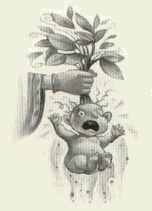
most antidotes, including one for Petrifaction. The Mandrake Restorative Draft returns people who are transfigured or cursed to their original state. Mandrake seedlings are tufty little plants, purplish green in color with what look like tiny babies growing where the roots would be. These creatures grow and develop over the course of several months until they mature and can be harvested and used for potions. The cry of the Mandrake is fatal to humans, so special care must be taken when growing them. Even as a baby, the Mandrake's howls can knock a person out for a couple of hours.
The Dugbog is particularly fond of eating Mandrakes.
Puffapod: Fat pink pods with seeds that burst into flower if dropped.
Umbrella-sized Flowers: These hang from the ceiling of greenhouse.
Venomous Tentacula: This plant has spiky, dark-red mobile vines and presumably some sort of jaws. It is described as “teething” in Book 3 and is quite possibly carnivorous.
Whomping Willow
|
ST: 10* |
Move/Dodge: 0/5** |
Size: 3+ hexes*** |
|
DX: 8 |
PD/DR: 2/5 |
Weight: 3+ tons |
|
IQ: 0 |
Damage: 1d-2 thr/crushing |
Origin: F (Harry Potter) |
|
HT: 12/150 |
Reach: C, 1-10 |
Habitat: F |
|
Fright Check: No |
This is a large, willow tree with animated limbs that stands on the grounds of Hogwarts school. It was planted in the early 1970s to guard one of the secret passages from Hogwarts into Hogsmeade. It is up to the GM to determine whether the whomping willow is unique to Hogwarts or is found elsewhere.
It blindly attacks anything that gets within the range of its branches, flailing with its limbs and branches, ignoring only creatures smaller than a dog and people it has knocked unconscious. Its weakness is there is a knot near its base, next to the opening to the secret tunnel, that “deactivates” its limbs. A creature that can slip through, or under its branches can press the knot. Alternately, an missile attack by a small object (anything with a diameter of 1” or less) or a thrusting attack with a staff or spear might also be able to press the knot, as long as the blow does at least 0 points of damage. It is also possible that a prone character, especially one that is moving slowly and carefully, might be to slip under the willow’s branches.
Chapter 4 - Magic
Magic is divided into four broad areas: Transfiguration (altering the appearance or form of an object or turning one object into another), Charms (adding properties to an object or person), Curses (nasty spells directed against another person - also called Jinxes) and Divination (spells that predict the future). In GURPS terms, the broad magical theories learned in classes on Transfiguration, Charms, etc. are treated as the Thaumaturgy skill, while individual spells are learned as skills using the magic system presented in GURPS Basic.
Transfiguration: This is the art of changing things into other things. This field of magic mostly seems to cover the Animal, Body Control and Illusion and Creation colleges, especially the spells Shapeshifting, Shapeshift Other, Alter Body, Permanent Shapeshifting, Merging Shapeshifting, Partial Shapeshifting and Great Shapeshifting. Other spells, listed below cover introductory and intermediate transfigurations. They are Transfiguration and Minor Transfiguration.
Spells from the Body Control College included in Transfigurations are Alter Visage, Alter Body, Decapitation, Shrink, Enlarge, Corpulence, Shrink Other, Enlarge Other, Alter Voice, Haircut and Hair Growth.
Spells from the Illusion and Creation College include Create Object, Create Animal, Create Servant, Create Mount, Control Creation and Create Warrior.
Charms: This is the art of adding properties to objects or creatures that they did not possess previously. This field of magic covers most of the spells from the other colleges, including the spells that affect the mind and the emotions. Essentially any spell that doesn’t involve physically changing an object or person and which isn’t particularly harmful to the subject is a Charm.
Curses: These are hostile forms of Charms and Transfigurations. This field of magic covers the hurtful spells from various colleges. Many combat spells fit into this category, as do spells that cause bad luck, pain or actual injury.
Divinations: This category of spells covers any spell that attempts to predict the future. It is the smallest category of spells. It covers several Knowledge spells and a few Protection and Warning spells.
Changes to Existing GURPS Magic
Magic in the world of Harry Potter is similar to the magic system presented in GURPS Basic, Magic and Grimoire, but with a number of exceptions.
Easier Enchantment: It seems to be much easier to enchant items in the world of Harry Potter and mages use enchanted items with the same regularity as muggles use electric appliances. To better simulate this, the GM should consider halving the price and energy cost require to enchant “mass produced” magic items. For ubiquitous and/or trivial items (e.g., gadgets like a Rememberall or Fred and George’s Ton-Tongue Toffees) the GM should consider quartering cost and energy cost. Powerful items, such as invisibility cloaks can still require the full cost to enchant.
Additionally, mages can take a break from enchanting an object. Halve the time required to enchant an object each day and allow the mage to put an object he is enchanting aside.
Easier Spells: The most important difference is that spells are easier to learn. Mental/Hard spells become Mental/Average, Mental/Very Hard spells become Mental/Hard and mages are allowed to learn a spell by putting only ½ character point into it.
This has several effects. First, low-IQ mages (e.g., students) can get respectable skill levels in a given spell much more quickly. When combined with the Missing Prerequisite rules, this allows young mages to “improvise” spells with very little practice and still have a decent chance of success. Second, by reducing the skill cost, it is easier for wizards to get fatigue reductions for high skill and allows spells to be cast without gestures. This better simulates the magic described in the books.
Eye Contact: At least with certain spells, eye contact with the subject of the spell is vital. The GM can normally assume that a mage establishes eye contact just by concentrating, but if the mage doesn’t have eye contact for some reason, the GM can assess a -1 to -10 penalty to skill, based on how familiar the mage is with the subject, the object and its location.
For example, if a mage wishes to summon his broom, which is in a familiar location and which he rides every day, he might only be at -1 to skill. If he is trying to betwitch an unknown foe hidden behind a wall, he would be at -10 to skill, if the GM ruled that he could cast the spell at all. If the mage knows the subject of the spell well, but cannot see the object on the subject’s body that he wishes to affect, he is at -1 to -4 based on how good his guess is as to the nature and location of the hidden object. For example, Mrs. Weasley would only be at -1 to skill to empty Fred and George’s pockets of various mischief-making devices, since she is all too familiar with what she is likely to find there . . .
If a mage has already established eye contact and it is subsequently broken, the GM can require a new skill roll, with the penalties described above to maintain the spell. He can also require a Will roll to maintain concentration if the mage is jostled, falls or is injured.
Combined Effort: If two or more mages cast the same spell at the same target simultaneously, add the total base energy cost of all the spells cast to determine the effective power of the spell. If the spell is increased to its maximum effect, the victim is at -1 per additional point of energy to resist the spell.
Default Spell Skills: Unlike standard GURPS spells, Mental/Average spells default to IQ-5 and Mental/Hard spells default to IQ-6 if the wizard can make a successful Thaumaturgy skill roll or has received some sort of formal instruction (which can be simple as hearing the appropriate “word of power”) from a wizard who knows the spell at level 12 or better. Like normal spell casting, default spell casting is at a penalty for each missing prerequisite spell or missing level of Magery. Levels of Magery count as levels of IQ when figuring defaults.
Spells do not default to other spells, only to IQ + Magery.
Faster Spells: A mage may attempt to cast a spell more quickly, by taking a -4 skill penalty per missing second of time, down to a minimum of 1 turn required to cast the spell.
Fatigue Cost: Fatigue cost is based on the mage’s effective skill, before modifiers for range, and target size and speed are taken into account.
Gestures: While most spells don’t require anything more than pointing a wand and speaking a command word, a mage can get a bonus to skill for using certain gestures, such as flicking and swishing his wand in a certain way. If the mage takes an extra second to perform these gestures, he gets +1 to skill.
Intent: A mage’s intent when he casts the spell can be as important as the spell itself. For example, technically, the “Expelliarmus” spell just disarms a foe, but if a wizard (or group of wizards) really wishes to incapacitate a foe, then the spell might have more powerful effects, especially on a critical success. Likewise, critical failures tend to reverse the intent of the spell rather than just its effects.
The most important aspect of this rule is that if characters spend an extra turn casting a spell specify the precise object they wish to influence, they get a +1 to their skill roll. For example, “Leviosa” will levitate items, but if Ron were to say “Wingardium Leviosa” to specify that he wished to levitate a feather, he would get +1 to skill. In any case, since the intent is the important thing, technically incorrect “nouns” still have full effect. (In game terms, this means that what the player specifies takes precedence over what the character actually says to trigger the spell.)
Learning Spells: Spells can be self-taught from books at half the normal rate, as long as the spell to be learned doesn’t have prerequisites, or the reader already knows the prerequisite spells. Likewise, a character may learn spells that he has successfully cast using his default skill, but at half normal speed. Spells can be taught via formal instruction at the normal rate or faster using the rules for Learning Skills Under Pressure from GURPS Compendium I.
Finally, if a character receives formal instruction in a spell or has access to a book that contains the appropriate spell, they may immediately learn that spell as long as they have at least ½ a character point available to spend. (This is a change from the normal GURPS rules that require a character to invest at least 1 point in a spell in order to learn it.)
Magic Items: Magic items work differently in the Harry Potter books than in GURPS Magic.
(a) Spells cast using magic items do not count as spells "on."
(b) Spells cast using magic items unaffected by any Shock or Stun penalties the mage might suffer (although he is still susceptible to Distraction). This means that the mage must still make a Will roll if he is attacked while using the item.
(c) Spells cast using magic items do not count against a mage’s "running spell count," for spells which have such limits such as Minor and Major Healing. (So a mage could use his own healing spell once and then use a magic item with a healing spell in it on the same patient.)
(d) Unless otherwise stated, magic items work automatically. No skill roll is needed to cast the spell. The only difference is that in Contests of Skill, the enchanter’s skill with the spell is used, not the mage’s skill.
Magic Words: A wizard casting a spell gets a +1 bonus to skill if he loudly speaks the word of command used to trigger the spell. If he speaks the word softly or whispers it, he doesn’t get the bonus, and if he doesn’t speak the word at all, he is at -2 to skill. This applies to default spell skills, as long as the mage knows the magic word. If the wizard doesn’t know the spell above level 12, he must always speak the word of command and cannot cast the spell silently. He does, however, get the +1 bonus for speaking loudly.
Mana Levels: For the most part, the world of Harry Potter is a Normal Mana Zone, but only characters with the Magery advantage can cast magic spells. It is possible that there are rare areas of intense magical activity that rate as High Magic Zones and certain areas that are Low or No Mana Zones. In any case, mana levels are mostly normal.
Missing Prerequisites: Mages can learn and cast spells that they couldn’t otherwise cast at -5 per missing level of Magery required to learn the spell, and -3 for every missing prerequisite spell needed to learn the skill. If the mage’s effective skill with the spell is reduced to 3 or less, however, he can’t cast the spell at all.
In theory this variant allows a wizard to learn a high-level spells quickly by bypassing all the prerequisite spells. In practice, the skill penalties will be so huge that mages will find it more practical to put a point into all the prerequisite spells.
Partial Spell Effects: Spells that fail by 1 or 2 points might have a partial effect, at the GM’s option. A spell that misses by 1 produces a weaker or less intense effect that still might have some benefit, for example, a Poltergeist spell to throw a pillow across the room might not throw the pillow accurately or it might throw something other than the target! A spell that misses by 2 will produce some trivial effect, for example, rather than turning the victim into a pig, the victim might just grow a pig’s tail.
Ranged Spells: Spells that are not cast by touching the target must be “aimed” on the turn they are cast. Apply normal Vision, Cover, Range, Size and Speed modifiers that affect the target to the mage’s effective skill to hit the target, and then subtract the PD from shields or natural or worn armor. The mage’s effective skill to cast the spell correctly is only limited by range. If the mage makes his skill roll by enough to cast the spell, but not by enough to hit the target, the spell is cast successfully, but misses its target. At the GM’s option, it might hit another target instead.
Characters can use the Dodge and Drop Retreat option to get out of the way of a spell. This gives the caster an additional -3 penalty (for the movement of the target) to hit the subject. Normal retreats have no effect, unless the GM rules that the target’s retreat protects him somehow - such as by letting him duck into cover.
Dueling Spells: If two mages cast spells at each other at the same time, there is a small chance that their “beams” will intersect, nullifying or deflecting one or both spells. Compare the die rolls for both mages, as if they were rolling a contest of spell skills. The mage whose roll succeeds by more has his spell take effect first. If the mages tie, both spells are deflected. Roll 1d randomly to determine the direction of scatter. If anyone is along the path of the “beam” they are hit by the errant spell on a roll of 9- or the mage’s adjusted skill, whichever is less.
Similarities: Spells, especially transfiguration spells, work better when there is some sort of “correspondence” between the original object and the desired effect. The GM can give a bonus of +1 to +2 if the mage is trying to change an object into another object with some sort of similarity - either in size, shape, appearance or name. For example, characters might get a +1 bonus to transfigure a guinea pig into a guinea fowl, or to turn butter into cheese. If an object has multiple “similarities” the GM can give a +2 bonus, for example, turning a beetle into a button (similar name, similar size, similar appearance, etc.)
Spell Side Effects: Spells usually have at least some visible or audible effect, such as a loud “bang” and/or a flash of light or swirl of sparks. Failing that, they require some sort of “prop” to produce their effects. For example, Divination spells always require the appropriate tools (a cup of tea, the subject’s palm, a crystal ball, etc.). Knowledge spells often produce some sort of visible effect, such as producing a flashing light or making a noise when they are triggered. The exact effect of a given spell is up to the GM.
Using Spells Under Stress: At the GM’s option, any spell cast when the character is under life-threatening stress gets +2 to his rolls to cast a single “defensive” spell, to a maximum effective skill level of 15. The GM’s word is law when determining what circumstances count as “life-threatening” and what sort of spells can be considered “defensive.”
Wands: While mages can cast spells without using a wand (and most mages do so spontaneously as children), wizards need a wand to work powerful magic. See the Wands Section below.
Divinations
Divinations and similar spells are notoriously fickle and unreliable, and depend heavily on a mage’s innate talent. In game terms, for a mage to learn any Divination spell, or other spell that predicts the future, he must have the Divination Talent. If he doesn’t have the talent, while he can still study divination to improve his knowledge of magical theory, or to use Divinations as prerequisites for other spells, he can’t effectively use the spell - he’s just wasting his time.
Furthermore, unlike all other spells, Divination spells and their ilk are treated as Mental/Very Hard skills, and the mage’s effective skill can never exceed 12, although higher levels of skill can be used to offset penalties.
Muggles and Magic
Wizards are aided in their campaign to keep magic secret by the muggle habit of ignoring or explaining away the extraordinary. When a person without the Magery advantage sees a spell or magic creature, first roll vs. Vision-2. On a failed Vision roll, the muggle refuses to notice the magical effect. On a successful Vision roll, roll vs. IQ. On a successful roll, the character explains away what he sees - he thinks it’s a movie prop, a hallucination, or something else. Only on a failed roll will the character not be able to rationalize what he saw. On a critical failure, the muggle will be convinced that what he saw was not normal. How he reacts depends on the character, but at the very least, he will talk to his friends about the event. In such cases, the Office of Misinformation and teams of Obliviators are standing by.
Technology and Magic
Magic interferes with mundane communication and sensor signals. Because of this, any device that relies on radio waves, etc. won’t work properly in areas where there is lots of magic. Attempts to use any sort of electronic device in a magic area, or interpret sensor signals reflected from a magic area are at -2 to -10, depending on the strength of the magic in the area and the strength of the signal. For example, a witch’s cottage half a mile away might give -2 to TV and radio function, but it wouldn’t interfere with a powerful ground to air radar unit. Attempting to transmit or receive signals from the grounds of Hogwarts School would be at -10 to skill, if the GM ruled that it was possible at all.
As a rule of thumb, assume that a simple electric device suffers a -1 penalty per TL5 above 5 when magic is in regularly used within a few hundred yards. Electronic devices suffer a -2 penalty per TL above 5 for regular magic use within half a mile, or -4 for magic use within 10 yards. Assume that any device with a penalty of -2 or more to routine use will be prone to malfunction, slow to start, and otherwise erratic. Assume that any device with a penalty of -10 or more won’t work at all, unless its user makes a skill roll. Some areas of the wizarding world (such as Hogwarts or Diagon Alley) are sufficiently magical in themselves that they count as “regular magic use” even if no spells are in effect at the time. For example: simple TL6 style power tools would be at -1 to skill when used near magic. TL8 electronic gadgets would be at -6, or -12 if magic was in use in the immediate area.
Wizards have developed a magic form of radio that ignores (or perhaps uses) the effects of magic on electromagnetic signals. Wizard radio signals are undetectable to mundane sensors, assuming that wizard radio uses the airwaves at all.
The Limits of Magic
Magic in the world of Harry is a bit more restricted than magic in a conventional fantasy campaign. According to J.K. Rowling, the most important differences are that divinations are unreliable, created items vanish within a few hours after being created and there are no spells that can raise the dead. It is also obvious that spells cannot be used to permanently transfer skills to another character or to learn skills more quickly than normal (except, perhaps, by raising IQ).
In GURPS terms, the most important difference is that some colleges of magic aren’t as commonly learned and might not exist at all. The GM should feel free to forbid any spell that he thinks could go against the spirit of the books and/or the campaign, or rule that they are rare, secret or Dark Arts spells. On the other hand, the novels describe (or hint at) dozens of spells not listed in GURPS Magic or Grimoire. The GM should feel free to add spells as he sees fit.
Rare Spells: Rare spells are not commonly taught and you can’t just learn to cast them from a book that you pick up at Flourish & Blotts. At the very least, the GM should require a Thaumaturgy roll to determine if a rare spell is possible and then one or more Research or Occultism rolls to determine where one might find such a spell. In short, learning a rare spell requires a quest.
Secret Spells: Secret spells are hidden or are restricted to students of a particular school or organization. Treat Secret spells as if they were Rare, but all rolls to discover the existence and possible location of a secret spell are at -4. If the mage can deduce the existence of a Secret spell, he then faces an adventure to get the spell, and he might acquire powerful Enemies if he succeeds in acquiring it.
“Permanent” Objects: All spells that create objects out of thin air and which have a “Permanent” duration actually only create those objects for 1d/2 hours (minimum 1 hour). Mages who make a successful Thaumaturgy skill roll can double this duration, tripled if they also know the spell at skill level 20 or better and quadrupled if they know it at skill level-25+. For example, Dumbledore (with remarkable skill levels with both Thaumaturgy skill and the Mass Create Item spell) wishes to create a number of sleeping bags. He successfully rolls against his Thaumaturgy skill, doubling the duration, but it is actually quadrupled since he knows the Mass Create Item spell at skill level 25+. The GM rolls a 4 for the base duration. This is quadrupled so the sleeping bags actually last for 8 hours before vanishing.
A created object can be made truly permanent for 10 times the base cost of the spell using the rules for enchantments.
Transformations: At the GM’s option, spells which work by transforming one object into another (e.g., a rat to a rutabaga) or by modifying an object (e.g., making a person grow a pig’s tail) are truly permanent if the spell is listed as having a “Permanent” duration.
Mind Control and Mind-Reading: Spells that allow a mage to “get inside” another character’s head or share powers, senses or abilities with another character don’t appear in the Harry Potter books. The GM can either forbid spells such as Mind-Reading, Lend Skill, Steal Skill, Suggestion, and Rider Within, or he can assume that they are M/H (or even M/VH) skills compared to the “average” M/A spell. Such spells are also presumably Gray or even Dark magic and are highly restricted. If the GM does allow such spells, he can also apply a skill penalty based on how far into the subject’s psyche or senses the mage wishes to delve. For example, a Suggestion spell might suffer no penalty at all, since it’s a brief, minor intrusion on the subject’s mind. Spells such as Rider Within or Mind-Reading might have a penalty of -3 or more.
The White and Dark Arts
In the world of Harry Potter, spells are divided into spells that are considered benign and spells that are considered “Dark Arts.” Though it isn’t specifically mentioned in the books, some of the spells used are just nasty, and might be considered “Gray Arts” if they are misused. For simplicity, spells can be divided into “White Arts,” “Gray Arts” and “Dark Arts.”
Dark Arts: Dark arts spells are spell that cause severe pain or direct injury, or which completely eliminate the victim’s free will. Presumably, they also include spells that summon or create monsters or which deal with demons or the undead. Hogwarts School (and presumably most other schools of magic) do not teach Dark Arts spells and restrict access to library books that contain Dark Arts techniques. Those schools that do teach the Dark Arts are considered to be somewhat suspect. Note that while some use of Dark Arts spells is tolerated in wizarding society, they aren’t considered to be “polite.” A known user of the Dark Arts would certainly have a Bad Reputation (as a dangerous, possibly suspect person) even if he is otherwise law-abiding.
Certain Dark Arts spells are illegal to use on another sentient creature. These are the so-called “Unforgivable Curses” that will result in a life prison sentence if the offending wizard is caught. The Unforgivable spells are those that completely control another person’s body, cause intense pain or kill outright. In GURPS terms, the unforgivable spells include Agonize, Control Person, Possession, Permanent Possession or Deathtouch spells.
The GM should assume that any powerful combat skill is “dark” and restrict its use accordingly. Characters who make a habit of using Dark Arts spells might have to make Fright Checks after repeated or particularly shocking or cruel use of the dark arts. If the character fails his Fright Check, he acquires a “dark” habit or characteristic. Eventually, reckless users of the dark arts will suffer from “evil” disadvantages such as Bad Temper, Berserk, Bloodlust, Bully, Callous, Fanaticism (Self), Greed, Jealousy, Intolerance, Odious Personal Habits, Megalomania, Sadism, Selfish and so forth.
Since Dark Arts spells are not socially acceptable, it is often hard to find information on how to cast them. A roll vs. Streetwise (Magical) and some discrete inquiries in Knockturn Alley might be required. A character who wants to learn extremely rare or powerful Dark Arts spells must roll at a penalty. A failed Streetwise roll might mean that other mages (or the Ministry of Magic) will ask pointed questions about the character’s motives and ethics. A critical failure might mean that Lord Voldemort or his minions might come calling, looking for a new follower - or a new threat to be eliminated.
Gray Arts: Some spells, while freely taught, aren’t very nice. In polite wizarding society, they are permitted for self-defense or sport dueling and might be tolerated in emergencies, but well-bred wizards shouldn’t make a habit of using them on other people. If using Dark Arts is like attacking with a knife or gun, using the Gray Arts is like punching or tripping someone. The law might overlook such things, but it’s a good way to make enemies. Wizards who routinely use spells that interfere with another person’s consciousness or body might get a Bad Reputation and might even acquire the Bully disadvantage.
Another type of “Gray Art” are spells that are (basically) harmless, but which are illegal. These might include spells that could easily affect the mundane world (such as many Technology spells) or which are potentially dangerous (such as creating new types of magical animals). There is no particular difficulty in learning the Gray Arts, but wizards who make an obvious habit of it might get a bad reputation.
White Arts: White Arts are spells that are harmless or beneficial and which don’t have any potentially nasty side effects. They include most Healing spells, Divination spells and spells that affect objects or unintelligent creatures in a relatively benign way.
Wands
". . . Unusual combination - holy and phoenix feathers, eleven inches, nice and supple."
-- Harry Potter and the Sorcerer’s/Philosopher’s Stone.
Spells generally require a wand as a focus. Each wand is unique and is matched to the mage who will use it, without his wand a wizard is effectively disarmed. Wands are also a symbol of magic power, by law a wizard has the right to carry a wand at all times while wands are prohibited to non-human creatures (although the goblins probably ignore and/or dispute this decree). A disgraced wizard is publicly shamed by having his wand broken in front of his peers.
Without a wand, a wizard is at -10 to his effective skill and his effective level of Magery is reduced by 1 when determining which spells he can cast. Note that a wizard who is reduce to Magery 0 can still cast spells, but at a penalty for each “missing” level of Magery. Remember that if a mage’s effective skill with a spell is reduced to 3 or less, he can’t cast the spell at all. Given the increased chance of a critical failure and the low chance of success to cast spells without a wand, prudent wizards will surrender if disarmed.
With a wand that is properly attuned to him, a mage gets a +2 bonus to cast spells. If a wizard uses another wizard’s wand, he can cast spells normally (i.e., no skill penalty or effective loss of Magery), but doesn’t get the +2 bonus.
Different Wands for Different Purposes: In the books, certain wands are described as being particularly good for transfigurations or charms; whether this provides any game effect, or is just a salesman’s pitch is up to the GM. If the GM rules that different wands do have different properties, he can rule that certain types of wands might give a further +1 bonus to cast certain spells or certain types of spells, if they are attuned to the user.
Making and Choosing Wands: Wizards can make their own wand using the Wand spell (q.v.), but most wizards choose to purchase pre-made wands. Commercial wand-makers learn the Wand spell at very high levels and generally produce a better product than the wizard could make for himself.
When a wizard purchases a commercial wand, the wand-maker will “fit” a pre-made wand to the mage by measuring his body and observing him. (Roll vs. Professional Skill (Wand Maker) to determine which combination of wand materials is best for the customer.) The proper sort of wand will “attune” itself to the wizard.
An attuned wand will feel warm in the user's hand. Often, when a wand first attunes itself to a wizard (especially if it’s the mage’s first wand), it will spontaneously perform a trivial, but flashy, magic spell (such as the Sparks spell) when the wand is first grasped as an outward sign that it has “bonded” with the wizard.
It is up to the GM to determine if a wand can become “unattuned” or if a wand can “reattune” itself to another mage if its previous owner dies or involuntarily gives up his wand.
Broken Wands: A broken wand is useless until it is repaired. Repairing a wand requires a roll vs. Professional Skill (Wand Maker). Improper repairs, such as gluing or taping the pieces of the wand together, allow the wand to function, but without any bonus for attunement and at -4 to effective skill. In addition, any normal failures of spells cast with the broken wand produce odd, unintended spell-like effects, such as bubbles, foul smells, puffs of smoke and the like. Critical spell failures produce spectacular, devastating results. Typically the miscast spell will affect the user with an extremely powerful version of the spell he was trying to cast, produce a reversed version of the spell, or both.
Priori Incantem: Wands that share identical core materials (e.g., hairs from the same unicorn, feathers from the same phoenix) won’t work properly against each other. This effect is likely to come up only as a GM-inspired plot device or as a result of a successful Luck or Serendipity die roll.
When wizards using two identical wands cast spells at each other using their wands on the same turn, the two wands will "lock" as their magic energies converge. On the next turn one wand will force the other to "regurgitate" the "echoes" of important spells that the owner of the other wand cast in the past. At the same time, both wizards are surrounded by a dazzling sphere of glowing golden webbing that acts as a force field and moves them in a random direction.
When the Priori Incantem effect occurs, roll a contest of the wand enchanters' skill with the Wand spell (usually 12 unless specified otherwise), plus any levels of Strong Will that the mage holding the wand has. The winner of the contest cancels the other mage's spell and "locks" both mages into the force field described above. Each turn that the winning mage holds his wand steady (by concentrating and making a Will roll) he can force the other mage's wand to release an echo of an important spell cast with that wand. Dark Magic spells definitely count as important spells! If the mage used the wand to kill a person, a ghostly "echo" of that person's soul will appear and can speak with the mage who won the contest. What the spirit says and how they react to the mage depends on their relationship to the wizard, their personality and the needs of the plot.
While the winning mage concentrates, both mages are surrounded by a shimmering force field that acts as both an Anti-Magic shell and a Force Dome that protects both mages. The wizards can see out of this dome and can speak to people on the other side but can't leave the dome. The dome lifts the wizards 2d yards in the air and moves them 1d hexes in a random direction each turn. If the winning mage can make a roll vs. Will-2, he can control the direction and height at which the dome travels, but not its height.
When the winning mage stops concentrating, fails his Will roll or lowers his wand, the Incanto Priori effect ends. Both spells fail (but the winning mage doesn't pay energy cost of the spell) and the losing mage is Mentally Stunned for 2d turns. Both wizards fall to the ground from the height they were at when the dome winked out of existence, possibly taking falling damage.
On a critical success or critical failure, the losing wizard's wand explodes for 2d crushing damage and he suffers the effects of both spells.
Examples of Learning and Using Spells
Example 1: In his First Year Charms class, Ron is introduced to the Apportation spell. He has IQ 10 and Magery 3. In GURPS Harry Potter, the Apportation spell is a Mental/Average spell which defaults to IQ-5. This is an introductory spell that doesn’t require any prerequisites or levels of Magery so he doesn’t suffer any penalties for missing prerequisites. His initial skill with Apportation spell is 8 (Ron’s IQ + 3 levels of Magery -5), 9 if he loudly pronounces the magic word (“Leviosa!”), or 11 if he takes an extra turn to make the proper gestures with his wand (“Swish and flick!”) and takes a turn to specify that he wishes to levitate the feather in front of him (“Wingardium Leviosa!”). Unfortunately, his wand is a hand-me-down from his older brother, so it isn’t properly attuned to him. If it was, he would get another +2 bonus, making his job easier.
After a few hours of frustrating practice, Ron finally understands the basics of Apportation (his player invests half a point of previously earned experience to let Ron learn the spell). Ron’s skill with the spell is now at (IQ + Magery) -2 or skill level 11; 13 if he shouts the appropriate magic words and makes the right gestures.
A few days later, Ron needs to use his Apportation spell to disarm a rampaging troll. His best normal adjusted skill with the spell is 13; but this is a life-or-death situation, so the GM rules that Ron gets a +2 bonus for using magic under stress. This gives him an effective skill of 15. He rolls a 9 a casts the spell successfully. The troll (with IQ 6) fails its resistance roll. Noticing Ron’s Luck advantage, and realizing that Ron’s intent is to eliminate the troll as a threat, the GM rules that the club flies out of the troll’s hand and lands on the troll’s head as it falls, stunning the troll and ending the combat.
Example 2: In his fourth year, Harry Potter needs to learn the Summon Object (see New Spells, Chapter 6) spell in a hurry. He has IQ 12, Magery 3 and already knows the Apportation spell, which is the prerequisite for Summon Object so there are no penalties for missing prerequisites. In addition, he has Hermione to tutor him. Using the Intensive Learning rules from GURPS Compendium II, Harry and Hermione spend 16 hours working on the spell. Hermione successfully makes her Teaching skill roll, so Harry learns the basics of the spell and puts 1 character point into it. Summon Object is a M/A spell, so Harry’s base skill is (IQ + Magery) - 1 or skill level 14.
The next day, faced with a ferocious Hungarian Horntail dragon, Harry uses his newly-learned spell in earnest. His base skill is 14, but he gets +1 for shouting the magic word (“Accio!”), +2 to for having a wand that is properly attuned to him, and a further +2 for using the spell in a life-or-death situation. He suffers a -1 penalty for not being able see his broom, but he gets a +1 bonus to his effective skill by taking an extra second to specify the item he wishes to summon (“Accio Firebolt!”). His final adjusted skill level is 19 - good enough to overcome any distance penalties and summon his broom.
Inventing New Spells
The process is similar to the process described on p. M16, but is considerably faster and cheaper. Use this revised process:
(1) The player tells the GM what sort of spell, in general, he wants.
(2) The GM determines if the spell is possible. He does not need to reveal this to the player. If the GM determines that the spell is possible, he decides what its powers, prerequisites, etc. will be.
The character must first make an "Idea Roll" vs. IQ to think of the spell. He must then roll vs. Thaumaturgy skill to determine if the spell is possible and to get a sense of how to go about inventing it.
(3) The wizard must now spend time in research - a number of hours determined by the GM. The hours of research do not need to be contiguous, as long as the mage keeps accurate notes. Use 40 hours of research as a baseline figure; for each level of Magery the spell requires, double the research time required. Multiply this number by the number of prerequisite spells.
For example, a spell that requires Magery 2 and 10 prerequisite spells would take (40 x 4 x 10 =) 1,600 hours of research time. Multiple wizards can combine their efforts to research the same spell. In this case, divide the total time needed by the number of mages working on the spell.
Each 40 hours of research requires $2d worth of research materials, multiplied as above. For example, the spell above would require $2d (x 4 x 10 =) 2d x $40 worth of materials per week.
(4) At the end of each research period, the GM must make a "research roll" against the mage's Thaumaturgy skill, minus a penalty set by the GM. A very simple spell might have a penalty of -4; a very hard spell would have a difficulty of -10. In addition, there is a -2 penalty per level of missing Magery required to cast the new spell, if the wizard doesn’t have sufficient levels of Magery and a -1 penalty for each missing prerequisite. If the mage makes his roll, he successfully invents the spell and can put ½ point into learning it. On a critical success, he can invest 1 point in learning the new spell. On a critical failure, the mage suffers a disaster, taking damage and/or losing equipment due to a fire, explosion or other catastrophe. Unless the mage is delving into the dark arts, there is no chance that he will summon a demon. Alternately, the GM can rule that the mage follows a promising but ultimately misleading research path and that he will automatically fail the next 1d research rolls until he gets back on the right track. Once the mage knows the spell at skill level 12 or better, he can attempt to teach it to other wizards. If the spell is impossible, no roll can ever succeed, and an eventual critical failure is inevitable.
If the wizard has access to a decent magical library and can make a successful Research skill roll, he may add +1 to his effective Thaumaturgy skill for that research period, or +2 on a Critical Success. Failure gives no bonus or penalty. Critical failure gives -2 to the skill roll. The GM can rule that a truly excellent library gives +2 on an ordinary success or +4 on a critical success. (The Hogwarts library counts as being “truly excellent” if the characters have carte blanche roam the stacks as they please and uninterrupted study time. Study time snatched between classes, with no access to the restricted section and Madame Pince breathing down the character’s necks, reduces the bonus to +1, or +2 on a critical success.)
(5) To research spell variations, use the same process as above, but use a base research period of 20 hours, with a penalty of -1 for a trivial change to the spell to -3 for a major change to the spell.
(6) A mage can attempt to “reverse engineer” a spell he sees being cast or that he knows to exist based on accurate accounts of its use. In this case, the mage must use the same process as for inventing spells, but no IQ roll is needed to think of the spell, and rolls to Thaumaturgy skill are at +1 if the mage is working from written records or +2 if he has actually seen the spell in use.
Example: In her 4th year at Hogwarts, Hermione wishes to invent a spell that will tell the caster which way is north. She has IQ 14, Research-12 and Thaumaturgy-15. The GM rules that the spell is trivial enough that it requires no Magery or spell prerequisites, and is, in fact, identical to the Find Direction spell from GURPS Magic. Hermione easily makes her IQ roll to think up the spell, and easily makes her Thaumaturgy skill roll to determine that it is possible. The base time period to research the spell is 40 hours, since there are no levels of Magery or prerequisites required for the spell, this number is not adjusted. Since the spell is very simple, the skill penalty to invent it is -4. Hermione starts by researching the spell in the Hogwarts school library. This is an excellent facility, so any bonuses for success are doubled. Hermione makes her Research skill roll, so she gets a +2 bonus to her invention roll. After 40 hours of work and study, she rolls vs. her adjusted Thaumaturgy skill of 13 (-4 for spell difficulty, +2 for a successful research roll). She rolls a 12, and invents the spell. She can now put ½ a point into the spell. She does so and now knows the spell at skill level 13 (IQ-2, +1 for Eidetic Memory). Since she knows the spell at level 12 or better, she can teach it to her friends.
The Standard Book of Spells
This section describes the Colleges of Magic described in GURPS Magic and GURPS Grimoire as they apply to the world of Harry Potter.
A Note on Names: The spells described in the Harry Potter books are usually described by the “word of power” that activates the spell. These names are usually (loosely) based on Latin. For example, “Oblivio” is the proper name for the Permanent Forgetfulness spell and “Leviosa” corresponds to the GURPS Apportation spell. In some cases, the Harry Potter spell and the GURPS spell of the same name have different effects (notably, the Apportation spell mentioned above). For simplicity, I have retained the standard GURPS spell names. GMs and players are encouraged to match the names of the spells described in the novels to spells given on the lists below.
In many cases, there is an underlying “word of power” that is applied to a specific object. For example, “Mobilarbus” (“Move Tree”) and “Mobilacorpus” (“Move Body”) both use the underlying spell of “Mobilirum.” While I have treated different applications of a similar underlying magical concept as different spells, the GM should be generous in letting similar spells default to one another.
Learning Magic at Hogwarts: If there are thousands of spells available, why then do Hogwarts students learn so few of them?
First, while Hogwarts students are extremely talented, they are still students. Presumably, much of their class time is spent learning how magic works, which increases their Thaumaturgy and Occultism skills.
Second, the books only show spells that have dramatic potential. Hogwarts students presumably know lots of spells, but presumably they are trivial spells that shine shoes, mend robes, change bedding and remove ink stains. These are handy spells for everyday life, but not much use in a crisis.
Finally, while Hogwarts students are intelligent, they are still not adults. The school faculty, being no fools, does not allow impulsive, hormone-charged teens access to seriously dangerous or disruptive magic. There are very good reasons why students are not taught the dark arts, and for why the really interesting spells are hidden in the restricted section of the library. Hogwarts students do a good enough job of maiming each other without resorting to spells such as Deathtouch or Explosive Fireball.
In a campaign set at Hogwarts, the GM should carefully determine which spells are available to the players and then stick to that list. If the players whine that a particular spell isn’t on the list the GM can either say “It’s in the restricted section of the library.” (i.e., It’s an adventure to learn it.) or “You’ll learn that next year.” (i.e., “No, you can’t have it, stop whining.”) In severe cases, the GM can rule that either Hogwarts doesn’t teach the spell or that the spell doesn’t exist.
Finally, remember that magic at Hogwarts, like elsewhere in the wizarding world is strictly bound by social conventions. Obnoxious students (i.e., players) will quickly get a bad reputation, either with the faculty, their fellow students, or both. Students who use magic destructively will face increasingly severe disciplinary measures. Attempted murder, arson, kidnapping and the like are all crimes, whether you use spells or more mundane weapons.
Changes to Colleges of Magic
Animal: All Spells in the college are available, although they aren’t very commonly used.
Body Control: All spells in this college are available and they are used very frequently. Unfortunately, many Body Control spells are "Gray" and some are "Dark."
Communication and Empathy: This college is greatly limited, and what spells are available tend to be Gray or Dark. Given that two of the three major Unforgivable spells are from the Communication and Empathy college, perhaps it is understandable that the whole college is held in disrepute. In the world of Harry Potter, there don't seem to be many spells that allow the caster to see inside the subject’s mind or to perform subtle alterations to the subject’s personality.
Elemental: Elemental spells don’t exist.
Earth: Most Earth spells (except element spells) exist, but they aren’t commonly taught, some are Gray.
Air: All Air spells (except elemental spells) exist, although some are Gray.
Fire: Most Fire spells (except elemental spells) exist, several are Gray and a few are Dark.
Water: All Water spells (except elemental spells) exist, several are Gray and one is Dark.
Enchantment: This college has major changes. Most importantly, the Scroll, Staff and Powerstone spells do not exist. To compensate, the cost to produce magic items is considerably reduced and spells are easier. See Magic, above.
Food: All these spells exist, but a few are considered Dark.
Healing: All Healing spells exist, with the exception of Resurrection.
Gate: This college is somewhat restricted. Spells that deal with alternate dimensions don’t seem to exist (or if they do, they are Rare or Secret). Spells that deal with time or which open Gates to other places on earth do exist, but are greatly restricted by the Ministry of Magic. For this reason, they might be considered to be Gray.
Illusion and Creation: This college is greatly changed. Illusion spells are rare except for Illusion Disguise, Illusion Shell and Simple Illusion. It is much easier to create objects (including semi-permanent created objects) so illusions are correspondingly rare.
Knowledge: This college is extremely limited. Spells that allow the mage to see or predict the future (such as Divination) require the Divination Talent. Spells that provide information don't just provide a "flash of insight;" instead, they report their information in a more tangible form. For example, the Seeker spell wouldn't just let the wizard "know" where the spell subject was - instead the spell might provide a map of the mage's area with the route to the subject traced out in red ink. While this has no effect how Knowledge spells are used or the information they provide, it is an important "special effect."
Light and Darkness: All spells of this college exist and they are basically unchanged.
Making and Breaking: Most spells of this college exist and they are basically unchanged. This college is presumably very popular given the essentially peaceful, practical mindset of the wizarding world.
Metaspells: This college is somewhat limited.
Mind Control: Like the college of communication and empathy, this college is very limited. Many spells in this college are considered to be Dark or at least Gray.
Movement: This college is unchanged and most spells are commonly used.
Necromantic: This college is either greatly restricted or most of its spells are Dark and either Rare or Secret. With few exceptions, the remaining spells are Gray. It is also quite possible that spells dealing with Demons and the Undead don’t exist.
Plant: This college is unchanged and most spells are commonly used.
Protection and Warning: This college is unchanged and most spells are commonly used.
Sound: This college is unchanged and most spells are commonly used.
Technology: This college is somewhat restricted, if only by the fact that most wizards suffer from the Primitive disadvantage. Because of this, Technology spells that deal with items of TL6 or higher is rare. Wizards who take an active interest in muggle technology, such as Arthur Weasley, are exceptional. The Ministry of Magic takes a dim view of wizards who enchant mundane items.